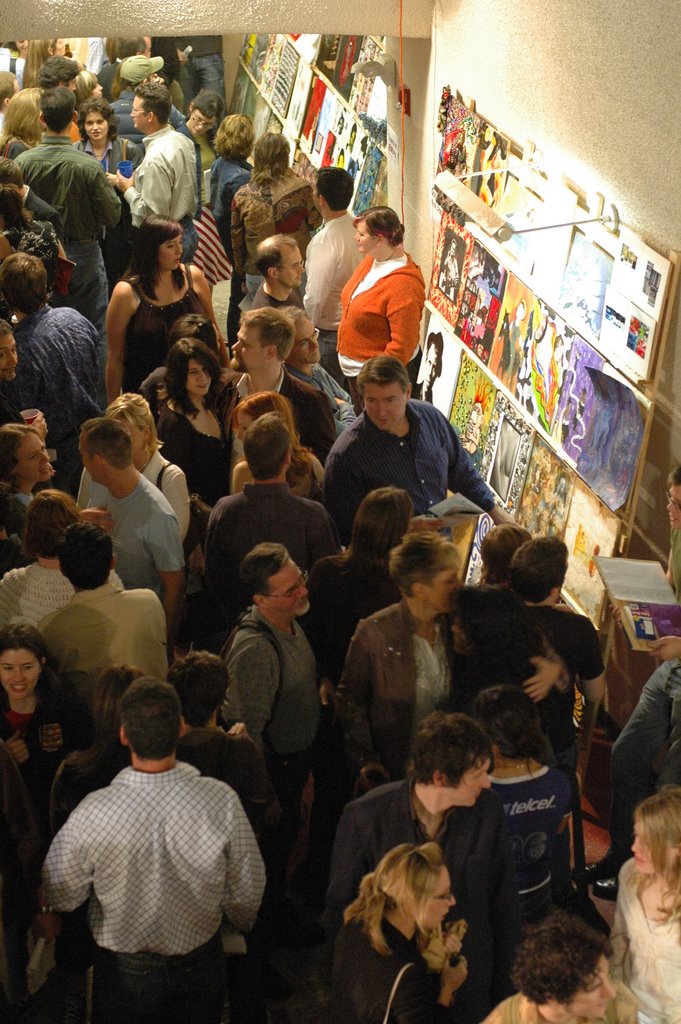
Art Conspiracy Dec 1&2 2006. Greatness. More later.
update: I'm participating. The art will be created on 11/30, and the show will be on 12/1.

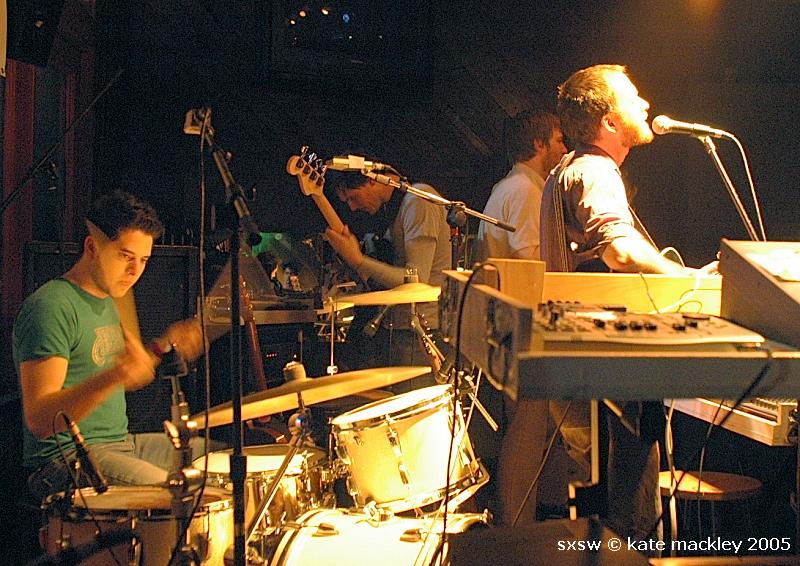
Midlake is experiencing enviable success. Tagged to play Coachella in 2005, chosen by actor Jason Lee for an appearance on The Late Late Show with Craig Ferguson, and ferried along for European tours by the Bella Union label of former Cocteau Twin Simon Raymonde and for American shows by Rilo Kiley, the Denton experimental rock band is fast becoming a media darling. Five indie guys with a bunch of artsy videos, Midlake spins spacey melodies that flow with grace and ease. Discussing the recording of their eagerly awaited third album, Midlake outlines a departure from the lo-fi, '60s inspired pop of Bamnan and Slivercork. Moving into the next decade of musical influences, The Trials of Van Occupanther draws from '70s folk rock and is a new direction for the ethereal group.
Eric Nichelson, Eric Pulido, and McKenzie Smith sat down with me for a lengthy interview this past June. As we munched tacos at Pepe's & Mito's on Dallas' Elm Street, we talked about how they've gotten better at recording and just how much I didn't really appreciate Bamnan and Slivercork.
Kate Mackley: Ok, first of all, tell me about Van Occupanther, how that’s going.
Eric Nicholson: It’s been a relatively long process again. We started in early November had an original plan of May to be done, and we got around earlier this year where we were doing pretty well, you know but this was going to take a little bit more time to complete. And so now we’ve given ourselves until November…
Eric Pulido: November of 2005.
EN: …to finish it up, and it’s going well. We’ve recorded six songs that are in, we're over 50% on two more; we’ll have to go back and add some things here and there in mix and stuff. It’ll probably be a ten or eleven song album so we’re probably 60-70% depending on how you look at it, so it’s getting there. And we’re looking at probably an early 2006 release, so it’s going well. We’ve been learning a lot as we record more, we record in our home and get new equipment and learn how or find out new things and so it’s been a good learning process. Frustrating, but good.
KM: Why frustrating?
EP: Learning how to record. We know how to record, but then we don’t know how to record… it’s probably a lot of the charm of our recording on our last album is that we really don’t know what we’re doing. So we just make it sound as best we can, and same thing with this album. We have a bunch of new gear and we’re having to learn how to use that gear, never having worked like this before. Just the learning curve, getting through that, and making it sound the best we can. We know what we like and we know what we like to hear, and getting it to actually happen is the difficult part, the frustrating part. That’s where the frustration is coming in but it’s nothing abnormal.
EP: Well, that’s why there are studios and producers and engineers. We always talk about “Man, it’d be great to just push a button and this guy would appear or this robot would come to life that’s like, "Yeah, you record that and make it sound like you know, Beatle’s “White Album” on this track and that’s what I want the guitar to sound like.” But it doesn’t happen, so we’re spending 75% of the time trying to get that sound. Playing the part wasn’t the hard thing; it was getting the sounds to sound right, so we keep getting these new toys and stuff to figure out. There’s a learning curve to employ those into the recording process. We don’t take a long time just because we’re trying to make people wait or we’re lazy or anything like that. I mean, we literally work 40 hour weeks [recording] on top of the 40 hours weeks we work at our jobs. It’s quite a process to get there, you know. It’s frustrating but fun.
KM: And why aren’t you guys using a studio or producer?
EN: Costs too much money. We buy the gear, pay the same amount of money to buy your own gear and learn how to use it. It’s a wiser investment. Cause you’re going to spend the exact same amount, if not more, on studio time. That’s all it is.
EP: And also, you can just go record whenever you want. Your studio’s right down the hall, you can go to your room, go take a nap, you can use your bathroom, you can go make coffee in your coffeemaker, you can go get a beer out of your refrigerator. You know, we’ve gotten so used to it now, it’s just comfortable. The only deterrent that was ever there was can we get the same quality that we would get? And we found that in a lot of ways it’s just as good or better because of the time. If there was an engineer behind it you’re going to get his input as well and you just kind of like lean on him and be like “OK, I trust that that’s good, right?” and you know, that’s cool, we got to move on now ‘cause time’s a wasting. But now it’s five of us in there and it’s like, “Is that good? Is that good? Is that good? I don’t know, let’s see.” It’s meticulous, and hopefully in all things we get to a point where the most important thing is this part of this sound. Sonically, does this song evoke, is there something emotional there that you can’t really put your finger on? So that’s the goal. Hopefully we’ll get that. We’ll let you know if we got that. Or you’ll let us know.
KM: The last album was a concept album, almost like a film, but audio. Is the next album going to be like that as well?
EN: Not as much.
EP: We’ll still have videos with the songs live. It won’t be as united as the last one of this land and balloons. There definitely was a conceptual idea behind the songs and they were tied together, whereas there are stories and such in the new songs, it’s just not as interconnected.
EN: These songs are definitely in the same world, the same vibe, as far as the sound of the songs. It’s definitely moved on to something different from our last album, but it still has a cohesiveness to it, but as far as the style of recording, it’s a little bit different. Though the style of songwriting, the vibe, is still there.
KM: Many bands, on their sophomore album, say, “We’re on a label, we’ll let them pick up the costs for us.” You guys aren’t doing that are you?
EN: No… (laughs)
EP: I mean, we’d like to, but there’s a lot that comes with that, you know. When the label gives you money, they also want to own it, they want to own everything, and a lot of what we’ve done has been our own way. Financially, funding things, it’s been difficult, but it’s kept things central, and we don’t have too many…
EN: ...outside influences.
EP: We made our album, we funded our album, and we own it. Bella Union licensed it from us and they do a 50/50 split with us on sales. If a big label over here wanted to give you a bunch of money, they’d say, “Well, I own the album now and you’re going to get 14% of the money that’s made on it, and anything else you put your name on I’m going to own too.” We don’t want to be big that bad, and there are no guarantees. Why can’t we continue doing things the way we are, where we’ve already recorded most of the album on our own dime, why don’t we keep finishing it out, and own it? There will be a label that’s willing to license it and let us still own our music and still get the music out there and get reviews and get features and get good shows. Slowly but surely we’re finding people that don’t make you give them your first born.
KM: Do you find that the music world is changing, because of the ability of the bands to do their own recordings?
EP: Oh, yeah.
EN: Yeah, it’s very viable nowadays. You can argue it’s going to take forever, but you can make a living, or potentially make money recording and making music.
EP: It's not like we just wrote a song, thought "it's great," and then recorded it. That’s not what happens.
EN:
McKenzie Smith joins us.
McKenzie Smith: The filter which it passes through now is just that much greater. I mean we literally compare everything we do to something that’s been done, that’s been great before. You have the task of finding something that doesn’t sound exactly like somebody else. If it does sound exactly like somebody else, then you hope that it’s something that nobody really listens to anymore or cares about, (laughs) but it’s almost impossible to find something entirely new. The other thing is, you don’t want to find anything that’s too creative and too bizarre that doesn’t connect with people. The filter is just getting smaller and smaller; that chance of going in there and sticking to what you actually want to do. Several years ago, before we ever even recorded our first EP, we’d been a rock band recording, rehearsing and practicing every night, five hours a night, playing the songs. But that’s never really like recording; looking back and asking that is the best it can possibly be? Figuring out every creative aspect. We did that for a year and a half before we played our first show. [When we went] into a rented studio we knocked out 13 songs in the three hour block and did vocal overdub. We did all the songs in two and a half hours, and Tim was expected to run through all 13 songs and hopefully get a vocal down in one or two takes, maybe, and we ended up rushing. It was very thrown together. It’s possible; you can make a record that way. If we had another couple of days to really work on it and finish it, that could have very well been an album that was released. But then again, it probably wouldn’t have been the greatest work we ever could have done. Now we have the opportunity to spend every night doing it, going, "Is this really the best it could be?" It does take a very long time. There are still things that take longer than you expect and what if it doesn’t sound good when you’re recording it? The mike’s not in the right place, the EQ’s not right, and then an hour and a half later, you finally solve the problem. And then you come back to it and you’re like, it's not right. (shaking his head, laughing)
EP: We’ve done that with whole songs….
MS: When we first started recording back in late November [2004], we spent an entire month recording a song, the first song we were working on… We chunked everything; a whole month’s worth and started over. So…
EP: … that’s why it takes us so long to finish an album.
MS: But when we talk about it, we struggle with it as well, because you know, we want to get it done, too. We want to be done. We want to get on with starting to develop the videos more and play live and put an album out. Even though we’re just this little indie band from
EN: A long time…
MS: (laughs) It is a long time, but I mean it’s worth it.
EN: You always got to keep that long-term perspective. That’s the only reason we’re still doing it, that’s the only way we’ve got through. We have to be thinking five years, ten years, fifteen years down the road. That you’re going to do this with your life; this is what you do. Luckily, we’re all able to come to terms with that. We talk to people and they’re like how do you get everybody on the same page?
EP: It’s a miracle how we got together…
EN: Yeah, you don’t get everybody on the same page… it just has to happen.
KM: Things are really starting to come together for you guys.
EN: It’s all about perception. I mean can we really be honest here?
EP: You’re always wanting more. I remember when playing a show was the goal. Then traveling somewhere to play a show, then making a CD, and then it’s people buying our CD and then it’s a label? I remember when Lift to Experience was on Bella Union and we had talked to them like “It’d be awesome to be on Bella Union and be like on a real label and tour Europe” and we talked to them, and it was just cool. It was the epitome of coolness for a band to have someone working with you, funding things, and getting you out there. Then we got on Bella Union, and all of a sudden we had a label and then a booking agent, and then it’s a festival, what would that be like? And then each thing comes and you want to keep pushing it.
MS: And the next thing is like, oh, man, a paycheck (laughs).
EN: Yeah, we don’t make any money. What it looks like on the outside, is not really what you would think it would be, and for us it’s not even… no way.
MS: And before we sound like arrogant jerks, these things are awesome, these things we’ve had happen are really cool. We’re not going to pretend they’re not cool. We have really cool people that like our band, or we can play some really cool stuff, and we can do some really great things…
EP: I didn’t come off like that, did I?
MS: No, I’m just saying that it could be taken the wrong way; if you print right there that oh it’s all perception, then there’s a million bands out there going “Those jerks. We wish we could have a record label, we wish we could do that” and it’s great, we’re very grateful we have these things. But at the same time, it’s always…we continue to work hard, to the next level and we just…we’re trying to make a career, we haven’t just arrived. Just because we have these things in place we finally feel like we’re actually sort of at the beginning now, OK, now we’ve got everything together let’s go do it, you know, let’s go. If we can turn on a thousand, OK, a lot more than that…a hundred thousand people in the world to our music, that’s kind of the goal.
EP: If a hundred people here in
EN: Getting a record deal, that’s not even the beginning, really. That’s part of it. It’s so hard just to do that, and then when you get that, then you have to make that work and that’s even harder.
EP: I don’t know…it’s a different equation for different bands, but I think the biggest thing that we’ve done, or the two biggest things—I guess they work hand in hand—but we’ve gotten, we’ve built everything in a very meticulous, patient way of getting people involved and getting entities or whatever. You get a label, you get a booking agent, you get friends, people in the media, you know a part of it. If you’re all the while working on your music and trying to create beautiful music and people connect to that, then ultimately they’re going to help move things along as well. It’s very easy to just crap out something and then be like, OK, now we’ll make it big. You kind of get ahead of yourself and it doesn’t really go anywhere. You wonder where you went wrong.
KM: Let me ask you about this, because I don’t get Bamnan and Slivercork. But, clearly, I’m missing something. A lot of people really love that album. Let’s put it this way, I tried so hard to listen to it and I make it through about 30 seconds of each song, and I’m like OK, next. Tell me what it is that I’m not getting?
EP: That’s a hard one. You have to go back to when you were growing up, what kind of music you listened to. Maybe pop music wasn’t to your liking.
MS: It’s difficult because it’s a subjective thing with music. I mean, if I looked at all the music I liked, there’s not necessarily this correlation where “Oh, that’s why I like Neil Young, and that mixes with this band.” There’s no doubt that there is in our music, particularly Bamnan and Slivercork, a quality to it that’s a little left of center.
EP: There’s a good chunk of people in the world that can get that album and it connects and says something to them. The lyrics aren't “Oooo baby, I’m so sorry I left you, I need you in my life right now” which obviously connects with a lot of people. The majority of the world buys that kind of record because that’s what they want to hear. People that don’t listen to that stuff, who are a little more off-the-cuff or whatever, they still haven’t quite gone into the world that our singer, Tim Smith, stepped into. [Bamnan and Slivercork] will never reach as many people as we would have hoped or liked to impact. I think it could reach a lot more than it did, but I still think it would take probably a certain kind of person that would enjoy that, and it is weird. But it’s not any weirder to me than a Beatles album that came out when they had a different lyric tone. They became weird but what they wrote about and how they wrote about it was still able to connect with a large group of people, obviously, but they already had set up a massive fan base anyway, so people were willing to listen to it. If the “White Album” had been their first record, they might not have had the success that they did. A band who has gone down a strange path like that, at some point early on in their career they’ve had more of a commercial success…
KM: Yeah. Because The Beatles' initial albums really were a commercial success.
EP: Yeah, so because of that, it kind of let them do [the later albums]. On our album, there’s a lot of imagery, some of it is kind of childlike.
MS: Some people come home, from the office—they’ve had a hard day, some people actually like that they can put on something that can take them to a completely different place like that. Some people say, no I want something I can relate to right away that’s going to help me get through my day in a different kind of way. Some people don’t even listen to lyrics and all they care about is this kind of weird band I like with these catchy melodies, whatever. People like music for all reasons. But I think honestly that a problem we had on our first album was that it might feel disconnected to certain people. I feel like the last album has taken great strides in fixing that.
EP: And you will like it…you might not get it, but you will like it.
EN: I think this music is way more mature. I mean, this album is not going to be put on by your average 15-year-old girl that likes New Found Glory or whatever…
KM: Ashlee Simpson…
EN: (laughs) It’s not going to be that kind of album, we’re not that kind of band. This music…I think the next album…I think it’s for adults. I think it’s very mature music.
EP: An older market.
MS: The influence in this album is different than the first one. The first one, we were still heavily into bands like the Flaming Lips or Grandaddy or Mercury Rev where it was a little bit more like ooh, we’re sort of weird, or quirky, and let’s throw some weird sounds in there. This album has nothing to do with that. There’s nothing on this album like that. It’s mostly like: here’s some acoustic guitars, and here’s some pianos and here’s electric guitar. It’s influenced by Joni Mitchell and Neil Young and Tim’s getting way more into '70’s folk. The recording process is different, the sounds are much different, the album sounds a lot different from the first one, just sonically. And then the songs are a lot different from Bamnan and Slivercork. The songs on Van Occupanther will connect with people in a more personal way.
EN: It’s the emotional connection, probably, even for yourself personally. It’s wanting to feel a certain way when you listen to music… you want it, you know. Even for myself, driving a car, sticking in an entire album, it might not grip on me; that’s just not the way I want to feel. It’s different for everybody.
KM: You’re right. It is all a personal, emotional connection.
EP: So hopefully, you’ll connect more with the second one. That way at our next interview you’ll say “I loved it.”
KM: Are you at all worried that you’re going to lose anyone who liked the first album?
EN: Oh, we might.
EP: All twelve of them.
MS: We had conversations about that…talking about the direction.
EN: I think it’ll open us up to many more fans, though.
EP: It’s just difficult because anytime we ever talk about something like that; it’s so hard to be objective about yourselves. When we finished “Roscoe,” we were confident that it was a good song, that it felt good, but what are people going to think about this? How will they think it compares to Bamnan and Slivercork? We let the label hear it, and Jason [Lee] heard it, and they really dug it.
KM: But what if they hadn’t?
EP: It would have been interesting, I mean…
MS: Rerecord! (laughs)
EP: Right. Well, it wouldn’t have been bad. No, because we felt good about it. If we were, if we would have felt bad about it…. Let’s not talk about it. (laughs)
MS: We showed Simon, who’s always been our greatest supporter. He loves it, you know. I know he would shoot straight with us if he heard it and was like “Man, I’m kind of worried about the new album, I’m not really digging this” - he would have told us that. But instead he was like, literally, "This is the best song I’ve heard in I don’t know how long, I can’t tell you!" He was freaking out about it, you know.
EP: The standard is if we all can sit back and all of us individually feel really really good and 100% confident, then at that point it doesn’t matter, you know. And that song that was definitely the case. I mean, this is good…
EN: And I don’t know if they would have felt the same if that would have been the first song.
KM: Can you actually describe your music? The new music.
MS: I think we used to use this description on our last album, but I think it’s actually starting to fit better now: "Influenced by rock albums, classic bands."
KM: Such as?
MS: Madonna, Huey Lewis and the News (laughs). No, such as anything from the Kinks, the Beatles, especially now the folk music stuff like Joni Mitchell, anything from Simon and Garfunkel, James Taylor, anything that’s got folksy or classic artists. Fleetwood Mac, right now that’s huge. Or Jethro Tull, anything like that. You don’t want to record an album that sounds exactly like it was recorded in 1973, and then everyone shows up at a gig wearing a jacket that everyone wore in 1973, because I think that’s novelty, that’s a throwback. That’s what most bands do right now. This whole '80s thing is so out of hand right now. I’m laughing at bands that that’s their whole shtick, because you’re going to be done. It’s over. It’s already on the way out. The '80s revival was cool and fun, but it’s going to die again. We’re not trying to be a '70s band, a revival. We’re actually just really in love with a lot of the records and a feeling in that time period. We’re trying to recreate that. There was good songwriting going on back then, which is not really present now. The feel of those albums and the songwriting and the personalities and the depth of the songs—that’s what we’re influenced by.
KM: But none of you actually remember the '70s…
EP: We were in there for about eight months.
EN: Yeah, you’re right, but from history, from looking back, we had this idea in our heads that "hmm…I bet it was like this."
EP: If you listen to the albums from then compared to the albums today, it seems clear to us, that there’s something going on there that’s not going on here.
MS: I’ve been listening to Duran Duran, I’m not going to lie, I think they’re an incredible band and they actually wrote really good songs, a little bit corny sometimes, but these really big, strong singers, great songs, and they all played their instruments really well. It had a good feeling to it, and you don’t hear that now. A lot of modern rock sounds so fake to me. I hate being the guy who likes strictly vintage, that everything vintage is cool, but there is some truth to that. We don’t want to be some like, trendy throwback band like the Kings of Leon. I’m not trying to dog on them, but when you look at them and you see the album artwork and it’s written just like it was, it has a shtick to it, like that’s kind of the vibe of it. We’re not trying to come out and dust off these 1970s characters and sport these massive handlebar moustaches, we’re not trying to be something that’s fake, we’re trying to be guys now in 2005 who happen to love stuff that’s older, from the 70s or whatever, and trying to make an album that sounds current today. All we want to do is make an album, that when people open it up, they put it in the CD player and go, "this is great," and they love it. When they come home from work, they put it on, and when they’re at work they listen to it, and when they’re in a car on a road trip with their girlfriend, they’re listening to it. That’s all we want to do with our music; we don’t want to be like some novelty act or some kind of trendy thing.
EN: Does that describe our music? Music that has been influenced by classic bands, classic albums, but we live in 2005 so we’re trying to make something that’s current. We just happen to be influenced that kind of stuff.
EP: We have no choice who we’re influenced by…
EN: That probably tells you nothing…
MS: It’s hard to place yourself in a genre. It’s hard to put words to what your music is because of perception. All you can really say is what you listen to and what moves you and what you’re trying to create. The only way you can do that, unfortunately, is say “With this song we’d been listening to a lot of Neil Young and that’s how it came out on this one.”
EN: It seems like the more you talk about it, the stupider we sound.
EP: Like when people describe the last album, they’re always like lo-fi psychedelic pop and I don’t know how to put those words onto the first album, either.
MS: Well, it’s lo-fi because we recorded it at our house, we weren’t really trying to be lo-fi, psychedelic because we used some weird keyboard sounds, none of us are on drugs, especially Tim, for sure, the singer, he doesn’t do drugs. It’s not like he’s writing this on some big acid trip, so I guess we’re psychedelic lo-fi music, I guess.
EP: Good luck with that one.
After the interview, the Midlake men treated me to a preview of their one kinda-finished (at that time) song, "Roscoe." We crammed into Eric Pulido's summer-hot, racing-red Mini Cooper outside the Café Brazil in Deep Ellum and cranked the volume. I made a bootleg copy with my iPod, but I swore never, ever to let anyone hear it. I haven't. The Trials of Van Occupanther will be out soon, and a non-bootleg version of "Roscoe" is available to listen to right now. It's on a Bella Union sampler, and the guys aren't exactly happy with it, even yet, so they'd rather you wait for the real thing. But I have to say, I do love it. I think I'll get this new album.
Originally published on www.dallasmusicguide.com
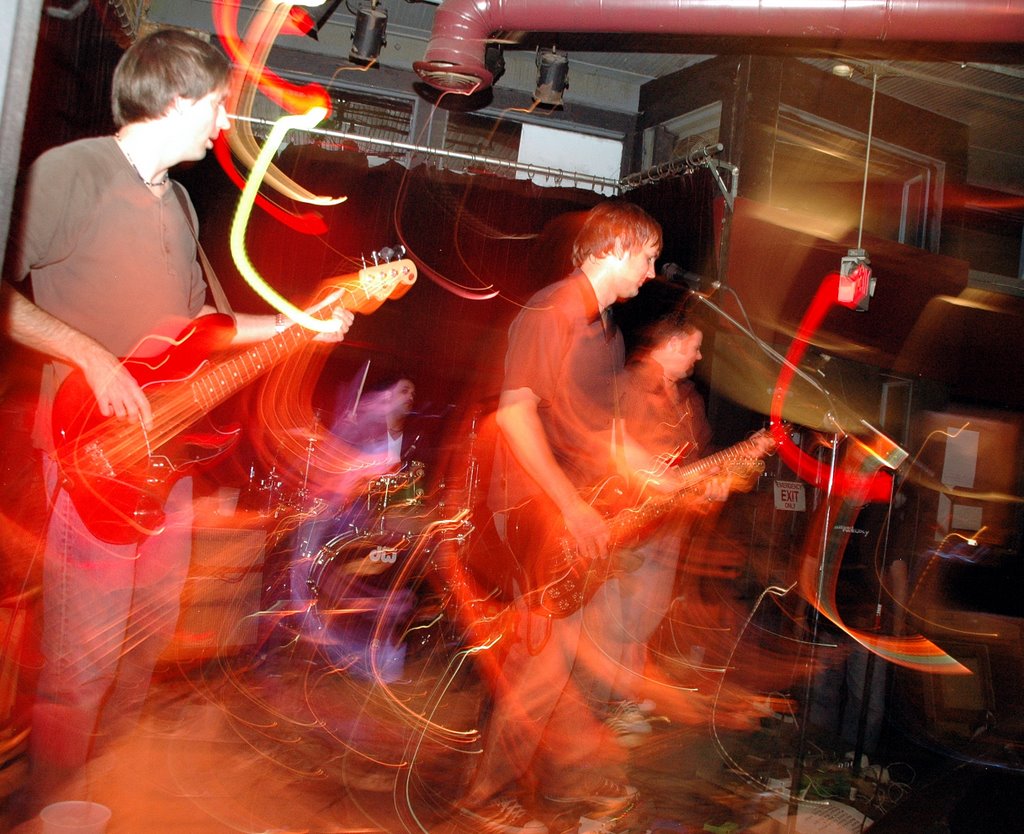
Downtime, Millicent Friendly
Produced by Purple Pear Studios, mixed by Derek Taylor,
Song highlights: "You," "
Originally written for TexasGigs.com
Lousy Robot Bio
“Being in a band is supposed to be dumb.” Don’t expect Lousy Robot to take their music too seriously. Jim Phillips, the self-described “cock-eyed optimist” doesn’t. The songwriter, he digs into the universal with his intimate lyrics. 2005’s The Strange and True Story of Your Life, Lousy Robot’s debut album, is a translation of a trying year into fun songs. “Enough of my personal life is already out there,” says Jim. Small talk becomes a cover for tragedy, a bad relationship is summed up in one word, “Gone,” the song that defines the Lousy Robot sound. Distilling sentiment down to its core is Jim’s genius, but the music is total fun that recalls the best of the Ramones and 80’s alternative rock.
“We’re one bong hit away from being a jam band.” That’s not exactly true. Jim and bassist Dandee Fleming, the founding partners of the band, are also a bit obsessive about their music. When it came time to record their first album, Dandee went out on a limb and emailed John Dufilho of the Deathray Davies, known for complex, danceable, fun tunes. John’s “happy chords” fit Lousy Robot’s pop-punk sound. John suggested they record with Salim Nourallah, a good friend who had a studio at his house. Not exactly the recommendation Jim and Dandee expected, they researched Pleasantry Lane Studio before signing on. “Oh, look, that’s a Rolling Stone article,” quipped Jim. Salim’s backyard recording sessions were definitely good enough for the perfectionist leanings of Lousy Robot. Salim and John now consider them good friends, and John even put it in black and white when he thanked Jim and Dandee on his solo album.
In 2003 Jim’s former band, “Hey Dandee!” morphed into Lousy Robot when Dandee joined the group, after which Jim said, “The name was kinda weird, so we changed it.” Lousy Robot’s completing members are Michael J. Fox, the latest, and hopefully last in a Spinal Tap-like succession of drummers, and Jack Moffitt, the keyboardist. Michael is a university-trained, Berlios-inspired, classical percussionist. Brought together by Jill, their hairdresser, Michael and Dandee found their personalities fit well. “I hadn’t been in a band since I was in college in
Just back from Pleasantry Lane Studio again, Lousy Robot’s still unnamed second album is nearly ready to go, and its expected release is in early 2006. “This time, it’s more rock, more driven,” says Dandee. With backup vocals by Johnny Lloyd Rollins and Cory Watson of Black Tie Dynasty, the next album is an amped-up progression from their first effort. If The Strange and True Story of Your Life is baby steps, the new CD is a good hard run at danceable rock. “The new album, touring, that’s what’s next,” says Jim, who recently left the corporate world to concentrate on the band without distractions. Jim’s urge to hold an audience and Dandee’s charisma put the band in firm running for a break out of the
Levi Smith Band
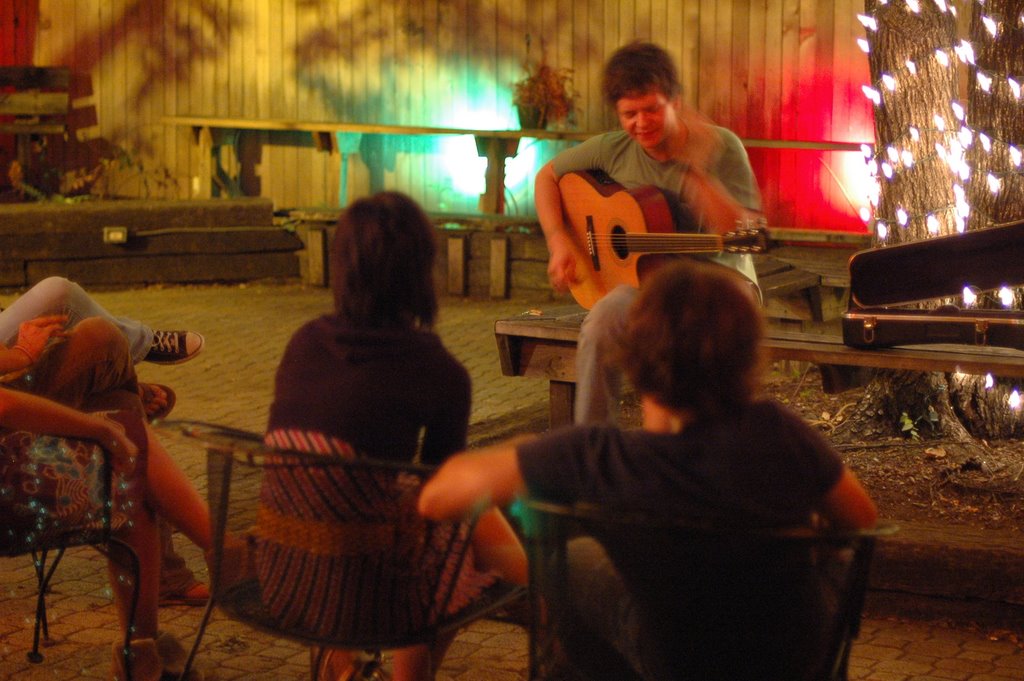
Levi Smith looks fifteen, sounds forty, and is twenty-one. Just old enough to redeem his drink tickets, he’s mature enough to write lyrics that span the gap from teenage angst to mid-life crisis. Smith finds the pith of emotions and zeros in without wasting words. His show-ending song, “Bitterness is Sexy,” is classic, destined for breakup mix-tape glory: “We can still be friends; that’s the consolation prize you gave me in hushed tones over gourmet coffee… I am lonely, but I need another friend like you need another compliment.” He’s a writer at heart, and chose songwriting as his creative outlet because it was immediately gratifying. As he puts it, “What are pancakes other than an excuse to eat syrup?” For Smith, lyrics are the pancakes to convey the syrup of his thoughts. What inspires a universal song like “Bitterness”? “It was my first break-up not because of me doing something wrong, being apathetic, but because of her. Before, honestly, I didn’t care. But this time, I had exhausted all the tricks in my 19-year-old book. I was younger and she just wasn’t interested.”
Taller than he seems, older than he looks, Smith is still awkward on stage. Toes turned in, boots scuffed, and cartoon shirt rumpled, he is mussed just right for the front row of smiling groupies. Evidencing his “god-given ladykiller” skills (per his MySpace and website) he plays up the emotions in the songs to good effect. More rocker than singer-songwriter, Smith’s set is consistant and backed by the bass and drums duely noted in the album title, The One with Bass and Drums. “Young emo chicks seem to like the music, and old men love our bass player- something about his tone...and his high cheekbones. I want to put myself in the place of old men, to write from experience,” Smith says.
Smith has tatoos on one arm only. “Feel.” (with the period) is written in script along his inner arm where he can see it as he plays. “When you play mainly in coffee shops you can't depend on dancing or distortion to cover mistakes,” Smith says. The tatoo is there to remind him of what’s important to his audience. A modified Mexican flag with the Lone Star instead of a Golden eagle in the center is on his upper arm, and a Stephen Crane poem over a music staff encircles his wrist. "If I ever lose the other arm, people will either assume it had just as much ink as this one. If I lose this one, I’ll be instantly clean-cut,” Smith explains about his unadorned other arm.
He began composing at age sixteen, but “began writing decent songs at eighteen.” He’s a prolific songwriter and stays up all night. “I love it when no one but cops are out at 3am, and that’s OK, ‘cause I’m a speed limit kind of guy.” Smith is from the Rio Grande Valley and calls Lubbock home, because likes the small-town feel of the city. “I’ve never been in a traffic jam there.” He has lived briefly in Denver, North Richland Hills, Roswell, Abilene, Wichita Falls, and Corpus Cristi, which was the inspiration for “What Are You Waiting For?” “I’m the ‘you’ in the song. It’s my potential talking to me.” His songs are literal expressions of his emotions, in the tradition of Country artists. “I like the straightforward honesty (of Country). You have to admire them for not being subtle--there ain't much guesswork,” explains Smith, “Even if you don’t like the song, you know what they’re singing about.” Smith says he’s mostly influenced by Ryan Adams, Cory Branan, Dave Matthews, and Tonic. He laughs. “Yeah, Tonic, because...I'm not sure. I suppose they're just one of those inexplicable habits like watching The Weather Channel for comfort.” Simon and Garfunkel were also an early influence. “Paul Simon wrote the first line of 'The Sound of Silence' in the bathroom as a kid and finished it when he was a grown man. I go through multiple drafts, and most of the time go back to the first draft because it was the best.”
Benefit for the American Red Cross, Hurricane Katrina Relief
Slick 57, Centro-Matic, Happyjack, [DARYL], Sorta
@ The Granada Theater – September 10, 2005
There’s something about Dylan Silvers. It’s not his looks, because he’s a little doughy, a bit pasty, kind of like a brunette Cousin It when he’s up on stage with his long sweaty hair covering his face completely. You don’t see his smile, you don’t see his eyes, you barely see him singing the words. There’s something about Dylan Silvers, but it’s not his image.
Maybe it’s his musicianship, because he writes some of the best pop songs coming out of the DFW music scene. On Ohio, one of the most acclaimed albums of last year, Silvers found a voice for his band, [DARYL], which is no longer '80’s retro synth. He loves to play the guitar. When he’s up on stage he’s expressing his innermost thoughts through six strings. But that’s not it, either, because there are a lot of good musicians in Dallas/Ft. Worth; numerous creative, talented, productive songwriters. It’s not his musicianship, though that is part of his persona.
Maybe it’s his personality; it’s who Dylan Silvers is. He’s no longer the miscreant who trashed the Bronco Bowl back in 2003, he’s responsible now. Somehow, this young guy, because he’s barely creeping out of his twenties, has brought around him the best musicians in North Texas. They want to play with Dylan Silvers. They want Dylan Silvers to play with them. When he’s down in the audience, they call him up on stage, and when he’s putting together a show, they’re there. That’s exactly what he did for the victims of hurricane Katrina. He put together a show to help those affected by the storm that wiped out New Orleans, a benefit for the American Red Cross, for the families of the hundreds who died, for the thousands of refugees who are homeless and living in Dallas, Houston, and anywhere they can. Dylan Silvers said, we have to do something. And he did. He took the best venue in Dallas, the Granada Theater, called up the best bands, living and dead, and resurrected Deep Blue Something. He got Toby and Todd Pipes to put together their band on short notice. “If he had given us more time to think about it, it wouldn’t have happened,” said Toby Pipes. “Dylan asked, we said yes, and they printed it in the paper, and then we had to play.” That’s exactly what happened. Silvers asked, and musicians said, ‘yes.’
Sorta said yes (and played at 8pm when The Drams cancelled), Centro-Matic said yes, and Slick 57 said yes. Centro-Matic had an online auction of their catalog and merchandise and heavily promoted the show. “Centro-Matic made the show,” said Silvers, “Mark (Hedman) drove this. He tagged it and took it home.” To add to that singular bill, three days before the benefit, Silvers formed a Who cover band that had never played together. Silvers was Roger Daltrey, Chris Holt was Pete Townshend with windmills, and they were backed by the uber-talented Carter Albrecht, Eric Neal of The Jones Thing on bass, and the “sickest drummer in Dallas” Scott Churilla from the Reverend Horton Heat. They formed a band that never existed, Happyjack, and may never exist again, and rocked the house. “This was the most fun thing I’ve ever done musically,” said Silvers, “We hadn’t even met before and we threw together three songs I could maybe sing, and the rhythm section knew those walking in. These guys are amazing musicians; badasses.”
Slick 57 played, the last band, it was one in the morning, almost nobody left, except the die-hards and the press and the photographer. Despite knowing that they’d be on after the last of Centro-Matic’s crowd had left, Slick 57 rocked it. Then John Pedigo and bassist Ward Richmond called Silvers up on stage. Though he’d already been backstage knocking back the celebration, he went out to jam with his friends and drive the show home.
Silvers is modest about his role. “I was lucky to be able to do something so fast. You give what you can, when you can, and this is the one thing I can do besides entertain people. I can put together a show that makes a difference, with music.” Resurrecting Deep Blue Something, that was pretty impressive. Putting together Happyjack, that was just plain fun. Putting it all together at the Granada and raising more than $4700 for our devastated neighbors, well, that’s just it. That’s just the something about Dylan Silvers.


 Photo Hosting


