Tuesday, April 12, 2005

Ian Moore Live at the Granada Theatre

Ian Moore / Radiant*

@ Granada Theater

December 2, 2004

Ian Moore’s “Society” could be a blueprint for the revision of the Granada Theater from second-run movie house into a beating heart of the Dallas music scene. The red-lit stage surrounded by violet candles is the perfect Ian Moore venue. The nearly gothic art deco interior infuses a luminescent counterpoint to the western feel of Moore’s music, evocative of the wide-open spaces of the human heart. This was a night of mellow rock by candlelight, opening with the spiritual melodic pop of Radiant* and culminating a long Ian Moore blues virtuosity.

In all fairness to Radiant*, it just wasn’t singer Levi Smith’s night. Babying his voice because of illness, Smith’s usual passion was only approximated. But with new strobes and a helpful soundtech, plus an especially heavy hand on the smoke effects, the show was as theatrical as ever. More low-key than usual, Radiant* set the laid-back mood for the night. Dragan Jakovljevic and Daniel Hopkins were intense throughout and Smith’s voice finally caught up with him on “Do Not Delay,” which they ended like a musical prayer.

Ian Moore’s obligatory black blazer, striped mod shirt, shaggy mop top, and vintage Levi’s jeans mark him as an indie rocker, but beneath the understated trappings, his heart is that of a bluesman. Still producing records on vinyl, Moore also admits to being a Bee Gees fan, who were better songwriters than their ‘70s silk shirts allowed them credit. Luminaria was produced in an alternative universe where music is the thread between friends. Moore brought a little piece of that world with him to Dallas. In “Ordinary People” -where ‘friendships are like fanzines’- Moore lamented the falseness of the underground with deep thumps on the kick drum that resonated in the audience’s heart and gut. Moore introduced “New Day” as a “simple song with a complex bridge, just like me.” His grimacing, tongue-thrusting vocals and punctuating drum added depth to the poignant lyrics. Moore promised “one more, and then I’ll get my friends up to do bass and drums.” The cool, higher vocal range of Paul Hiraga provided counterpoint to Ian’s warm resonant voice. They are, by their own admission, opposite images of each other. Moore is the light, Hiraga is the dark. Where Ian’s edges are rounded and mellow, Paul’s are more angular and strung out. Backed by Fernando Braxton blasting soulful horns, Lauren Fogle on bass (also an Austin-Seattle transplant who hung out with Ian as friends before being asked to join the tour), and Travis Garaffa (formerly with The Picket Line Coyotes) on drums, Moore relied on the band’s accompaniment for only about a third of the set. Musicians came and went from the stage as if at a jam session. It was all very relaxed.

Not going for the buck, but rather the pure glory of songcraft for an appreciative and responsive crowd, Moore was true to his muse. His songs are sung with mature emotion, an energy tinged with sadness. His progression from rock into folk is not a departure but rather an evolution of his music. The feel of Luminaria most closely resembles the longing of “Blue Sky” from Moore’s 1993 self-titled album. He played for an hour and half, a set not derailed by a broken string, and filled with the ability to evoke intense aching; songs about a mother’s death, friends who didn’t show, and many beautiful women. Moore’s genius is shepherding us into a mood that encourages putting your head on a lover’s shoulder and sinking into the depth of the songs. Moore creates a place you don’t want to leave. The minimal but cool light effects bled up the walls, and spots ran over the audience and amplified the brilliant, dreamy atmosphere. “It’s gothy- god damn, I left my mascara at home,” joked Moore, “This is a beautiful place; I wish we had something like this in Austin. It’s a wonderful spot, I’m grateful to play here.” The saying goes that you should never meet your heroes, as they will turn out to be just people. With Ian Moore, that is a blessing, not a curse.

-- Kate Mackley

Ian Moore is returning to Dallas on Dec 30th at Bend Studios to promote Luminaria, his latest release on YepRoc. Paul Hiraga can be found in Downpilot.

www.ianmoore.com

www.downpilot.com

www.yeproc.com

Set list:

What I’ve Done

Caroline

Kangaroo Lake

Blue Sky

April

Waterloo

New Day

Abilene

Ordinary People

Everyday Dream

Cinnamon

Today

New Orleans

Closer

Porpoise

Originally published ©2004 Dallas Music Guide

Sunday, April 10, 2005

Ian Moore at Bend Studio


Ian Moore at 36 has mellowed. Still unique, far from ordinary, he’s leading his passionate pursuit of music around the country. Thinking back on Dallas and Austin, wondering when he’d make that one great album, he joined DMG for an evening of candlelight and quiet conversation at Bend Yoga.

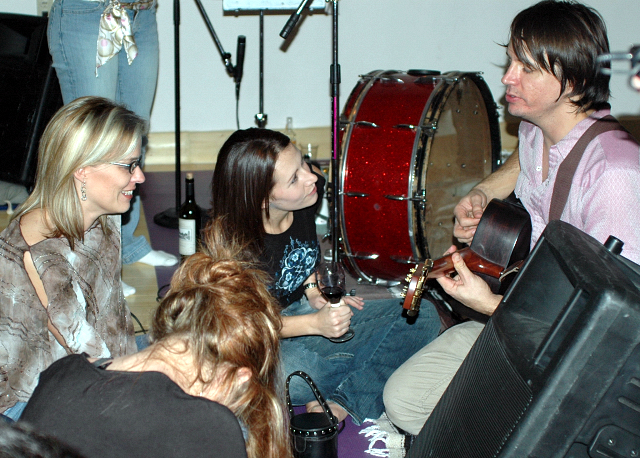
Surrounded by the aroma of patchouli, candlelight, and the simple Zen décor of Bend Yoga Studio, barefoot and stretched out on my back at his feet, I’m absolutely sure I’ve never experienced an Ian Moore concert like this before. The website promised an ‘intimate evening.’ They weren’t kidding. Reclining on serapes and soft pillows, sipping BYOB spirits, the lucky admirers on the studio floor gazed on the blues-rock guitarist lovingly and he responded in kind to the evening’s increasing affection. But before my slow slide into wine-soaked adoration, I managed to sequester Mr. Moore for some pleasant conversation about Dallas, Austin, ordinary people, and the pursuit of creativity.

Dallas Music Guide: How is it being back in Texas?

Ian Moore: I have a harder time in Texas than anywhere else; it’s a little like going home to your family, like high school. You have a history. I’m not complaining, I’m very happy and feel lucky that I haven’t lost my fan base with the changes (in musical style). People stuck with me, but it’s hardest to get press in Texas. It’s interesting; the Dallas Observer is probably the only major weekly that hasn’t reviewed my record. At least of the towns that I play. I’m sure that there’s some I’m not aware of, but you know… Maybe they’ve reviewed it, and I didn’t see it, but I don’t think they have.

DMG: I don’t think they have.

IM: Well, in Austin -which is my home town- The Chronicle was late, too. I think a big part of it is that I left Texas. Texas is a very very provincial state. It has an idea, almost more than any other state in the country, of what it is and what it is to be a Texan. A lot of that is pretty cartoony, and I think anybody grows past that, hopefully pretty quickly, and into themselves as an individual, but I think people take it personally when people move out of Texas.

DMG: Yeah, I can definitely see that. You mentioned in conversation, at your show in December at the Granada, that there used to be a conduit between the Dallas and Austin music scenes that you don’t think exists any more.

IM: Well, I don’t know. It doesn’t exist within the community that I’m aware of. There may be. I’m sure there are always new groups of bands. But I don’t see a lot of interplay between Dallas bands and Austin bands right now. I’m not aware of it. That also came out when we were talking to (Billy Potts) in The Lord Henry. He was talking about not really knowing many Austin bands and I was like, ‘that’s strange’ because when I was growing up, I knew pretty much every Dallas band, even at 19 years old. I did shows with them when I came up here and they did shows with me when they came down (to Austin).

DMG: I hope that’s changing. But it would have to start again, and it doesn’t exist right now. I think there’s a little bit (of interchange) but I don’t think there’s much.

IM: Well, they’re very different communities. People that live in Austin are often very different from people that live in Dallas. Dallas is pretty conservative.

DMG: When you were playing before, you knew a lot of bands in Dallas?

IM: Yeah, tons. I did shows with Ten Hands, To The New Bohemians, Mike Dane who was in a couple of bands. We used to play with and stay with them, all hang out and it was just a very tight community. I notice there’s a very tight community in Dallas.

DMG: Right now or previously?

IM: I really don’t know because most of the bands that I’m aware of from North Texas are from Denton. I know Deathray Davies, I know the Kadane brothers –I don’t know them, but I know their music- I know Brent, the Slobberbone guys.

DMG: Yeah, they just broke up.

IM: Yeah, I saw that. That’s the world that I’m aware of. Most of these bands are from Denton and I don’t really know many Dallas bands, at all. I knew those guys in Mur moved to L.A.; they opened up for Centro, they were really good.

DMG: You also mentioned that when you were starting out in Austin, you felt like you were ten years either too late or too early with your music and you were trying to do more experimental things.

IM: Well, no, just my influences and where music’s at now, it’s much cooler. The kind of stuff I was into then is considered much cooler now. It wasn’t cool to be arty back in those days. (The Austin music scene) was going through a bit of a thing like that a few years before me, but then it was really back to this macho kind of stuff. It was a short-lived thing, but definitely it was most of the people I was aware of. It was a pretty macho town back then. I kind of fell into that a little bit; I think I definitely simplified the stuff I was into. When I first started playing, I was taking sitar at UT and I’ve always loved ‘50s music a lot.

DMG: What’s your favorite ‘50s band?

IM: Well, my favorite musician in modern music is probably Buddy Holly. Just love him. He’s the basis of everything. So much of the Beatles is Buddy Holly. Especially the stuff that I think eventually morphed into their experimental side. He was so experimental; people don’t realize that. They think of the ‘50s and they look at him and he’s just like Elvis. But he did things like playing drum parts on his knee. People didn’t do stuff like that. Especially to think that he was recording in Clovis, New Mexico. If you’ve ever driven through Clovis, you get an idea. That guy was a real vanguard and he was really amazing. Nothing happens on a timeline, but I’m just glad to be finding more people that I share stuff with these days.

DMG: Do you feel more at home in Seattle than in Austin?

IM: So much of my life has been traveling that I really don’t feel home in a place, I feel home amongst different groups of people. It’s not so much a material place. I really like where I live, and I spent a lot of time in Texas, so I don’t really feel like I’ve necessarily moved, because I’m really not gone any more than I was back then.

DMG: What was growing up like for you? You had a pretty cool childhood, didn’t you?

IM: Well, yeah. Definitely did some cool things. Folks were cool, got to travel a lot, surrounded by a lot of really interesting people. But also, it was really hard because growing up in the ‘70s in Austin with parents that were counterculture, was not… you know, everyone gets teased a lot, but man. Outside of the typical teasing that kids get just for being alive, which happens to all of us, having your parents… my mom didn’t wear a bra and she wore toe rings, and my dad smoked weed and was very intellectual and very much his own person. I got a lot of shit growing up because of that. I alternated between trying to tone down who I was and saying ‘fuck it’ and being really outspoken with my beliefs. It’s very similar to who I am as an adult. My mom taught me to be a bit more demur about things. She was from an old money family so she understood the nature of gentle protest. My dad’s from a second generation Jewish family, all his ancestors were annihilated, so he had no need to be gentle about anything. Shouldn’t have. So I’m the by-product of the two of them.

DMG: Like polar opposites coming together.

IM: They were. That was the beauty of the ‘60s; so many cultures that really hadn’t meshed that often were intertwined. My mom came to Texas, I’d say, on the magic carpet of Joan Baez, ‘We will overcome, let’s help the poor minority people’ thing. Typical late ‘60s liberal -rich liberal- mentality and my dad came looking for beatniks to Austin because that was the closest to El Paso. So they met in Austin. She was probably attracted to him because he had elements of the things she was looking for, and probably to my dad, she was a good foundation and seemed pretty solid.

DMG: In your music, it seems as if there are two groups of people in your world. One, the ordinary souls, the rest of us that lead lives of quiet desperation, and the others…

IM: (interrupting) I’m making fun of myself, by the way. It’s a jab at feeling like you’re different, actually. It’s the Randy Newman school of thought; you put out something ridiculous enough that makes you look like a real asshole, like ‘Short people got no reason to live.’ That song’s obviously an irony. Put it out for other people to grab. I’m not that pretentious to think I would write a song like that. Well, I mean, I can’t… (shakes head).

DMG: What?

IM: Well, it’s just funny. I remember fans of mine mailing, ‘What does Ian have against fat people?’

DMG: Why? (laughs) Because all your ‘friends are pretty and thin?’

IM: My friends aren’t like that. I live on an island, I’ve got two kids, I garden and cut wood. I don’t hang out with a bunch of fuckin’… you know, those are not my friends. I actually don’t hang out with people like that. A lot of my friends are like Borkowski characters and the rest are Mormons; I’m a little bit somewhere between. Really, it’s not… I don’t have that many rock-n-roll friends.

DMG: Here in Dallas, people think I’m nuts; I’m going down to Deep Ellum and I’m a woman. I tell them, ‘It’s not like that.’ Musicians are normal people and who are just making music.

IM: Dallas is a very conservative town. I mean, it really is one of the most conservative towns in the United States. It really is. You wouldn’t think it. I’ve spent a lot of time in this town, outside of Austin and Houston, I’ve probably been here more than any other town in the country. It’s ironic, even the crazy people I’ve toured with are more mellow than the average normal person. I’m always amazed, when I stay with people that are more traditional, beer-drinking, typical people in their twenties, at how wild they are.

DMG: Do you think they are still rebelling against how wild their parents aren’t?

IM: I don’t know. I don’t know, but I don’t understand it. I don’t like staying in places like that because I like to sleep at night. I don’t want to live in a frat party. I know when I was young and I would date girls, their parents would always be really wigged out at first and I was always like, ‘Judge me as a human being, see what I’m like.’

DMG: Yeah, everyone is bummed you cut your long hair.

IM: (shakes head, laughing) Isn’t that sad?

DMG: Well, you had good hair.

IM: I mean, think about that for a second.

DMG: It’s like your hair defined you.

IM: (sarcastically) Yeah. That is… that is ridiculous. I mean, it would have been one thing if I had grown up in Teen Beat magazine and I’d ascribed to that. That the length of my hair has anything, in any way, to do with the music that I’m doing is something that I can’t even conceptualize.

DMG: It’s the outward appearance, the easy Cliff Notes to ‘this is what he must be like on the inside.’

IM: People need to work on their imaginations.

DMG: What image do you think you’re broadcasting these days?

IM: I have no idea. I don’t know. I have no idea. I like Paul Weller (The Jam, Style Council) a lot. I’d like to look like him, but I don’t. So, I have no idea.

DMG: I have to ask you about a lyric: “I live a life, that’s what it is.” There two meanings to that lyric.

IM: Yeah.

DMG: How did you mean that?

IM: Both ways. Too many people go through life and they just get by. But I know the truth.

DMG: Can you tell me a little bit more about that?

IM: My life is a life that I live. So many people talk about the nature of life: ‘So how was your tour?’ or ‘How are you doing?’ Those kind of things that you already know what the answer is going to be before you ask it, most of the time. Probably some good stuff happened, some bad stuff happened; I was tired, I had a few good gigs, some bad gigs. People are either enthralled by my life and totally romanticize it or, and this happened the last time I was here, this girl came up after the show, because I was talking about my kids from the stage, she said, ‘I think it’s really arrogant of you to be on the road and to be away from your family and to be playing music. You need to put your children first, before anything.’ I said, ‘I agree with you, and I do, and you don’t know anything about my life.’ So she was coming from the opposite space of her perspective of what I don’t have, instead of the fact that every path that you take is a series of pluses and minuses and you make choices to change the path you’re on, depending on what you want to do in your life.

DMG: You’ve said that if you’re home, you sometimes get frustrated and want to get back out on the road.

IM: I don’t so much want to get back on the road, I just want to… You know, I’m thirty-six years old, and I still feel like I haven’t really made a great record, the record that I want to make. I try not to get into the thing of being in a race with time, but I do know that it gets harder and harder in some ways. The great irony of acquiring wisdom is that there are less and less people to share it with because wisdom is an individual pursuit. And you gain your thing and it separates you from people. I’m on my own path and I don’t have a lot in common with a lot of people the older I get, whereas when I was younger and I had less life experience, it was easier for me to be part of a group.

DMG: But thirty-six? That’s young, that’s just starting.

IM: Well, I know. I don’t feel old that way, I feel old in the fact that most people in their thirties have completely given up on a creative life. They’ve just accepted it, through having kids. I see the struggles; it’s hard, it really is difficult. I’m a chef, I love to cook, but when I’m not home, my wife very rarely cooks because the kids aren’t gonna want to eat it. Who’re you going to cook for? And do you really have the time to spend the time to cook? Then at the end of the day, you’re psychically so tired, it’s much easier to sit in front of the television and watch a sitcom which deadens your brain and your soul, than it is to write or sew or create. But you can’t shut people down, the energy inside comes out some way. You need to feel fulfilled as a soul. Some people fool themselves and have a nervous breakdown at forty-five or fifty, shut down by societal interaction. So, when I’m home for a while, I get the urge to dive in and use my time to do something that I’m hoping is going to be great. Which I know is the carrot I’m never going to catch. That’s the pursuit of art.

Ian Moore returns to the new location of Poor David’s Pub by South Side Lamar on Sunday, January 23rd for an evening that may be a little less intimate, but just as creative. His latest album, Luminaria, is a beautiful, folksy ride thorough his gothic world. Just the perfect listening material for a Sunday.

www.bendstudio.com

www.ianmoore.com

Originally published © 2005 Dallas Music Guide

Saturday, April 02, 2005

Wednesday Nights at Sons of Hermann Hall

Wednesday nights at Sons of Hermann Hall, swing dancers pair off in the upstairs ballroom, but downstairs at the long bar a secret society quietly meets. Or not so quietly, as the night goes on. “I love this place,” grins Spammie Lamm, drummer for indie band [DARYL], “there’s always some sort of drama.” Tonight the drama is a partnerless blonde girl from upstairs who’s invaded the bar and has taken to slobbering on and with Aaron Silvers, Spammie’ s good friend, and brother of Dylan Silvers. Dylan is the reason we happen to be hanging out here on an otherwise drama-free weeknight.

Sons of Hermann Hall is the farthest outpost of the Elm Street scene, so far removed from the flash and trash of Deep Ellum it should be properly called Exposition area instead. It has its own charm. Sons is a lodge house, not a former lodge house, but an actual ‘we’re the brethren and this is our place’ working fraternal order. Since the 1930’s, the good German brothers thought it would be cool to open their house to bands. Once a dancehall and bowling alley, the floor of which can still be seen in the downstairs venue, Sons is now host to music and ghosts. It’s a creaky old place and the volunteers who have been alone in the hall tell spine-tingling stories about voices in empty rooms and noisy doors. But the ballroom upstairs has great sound, the booking agent has an uncanny ear for quality musicianship, and the beer is cheap. It’s a secret hideout for the real Dallas indie music scene; serious musicians who are also serious drinkers. At the carved wooden bar that stretches half the length of the peachy red Budweiser-emblazoned front room, members of the metroplex’s best indie bands come and go and the members of [DARYL] just stay. Next to the dusty 1970’s bowling trophies and under the American Idol logo, songwriter Dylan Silvers carries on his misspent youth into misspent adulthood, tending bar with his brother and keeping his friends happily sloshed. That his buddies are also his band is a happy accident, as the song goes. After years of searching for the proper combination of personalities and musicianship, [DARYL] the band has finally settled down into a bunch of guys that think the best way to spend a Wednesday night is drinking together.

Silvers has found a perfect six in the current members of his band of merry men. The rebirth of pop rock band [DARYL] with a new concept album, Ohio, and a new sound, stripped of discordant synthesizers and deepened with mellotrons and reverb, has brought an end to the changes in membership. Michael ‘Spammie’ Lamm is the only original member of [DARYL] to have survived every iteration. Guitarist Dave Christiansen was in the original incarnation of four musicians and returned after a hiatus, as did Jeff Parker, on bass, who confirms, “If we weren’t playing music together, we’d all be sitting up here at the bar drinking together and having fun. That’s where the positivity comes from.” Life is better with friends. Hanging at Sons out on a Wednesday night is much like getting together in your best pal’s place, if it had a fully-stocked bar, instead of a six-pack in the fridge. Discussion ranges from who’s playing where this weekend, to the relative musical value of Zooropa. The bar is passionately split between those who appreciate new U2 and the purists who prefer their Irish pre-Achtung Baby.

“We decided to combine everything together; drinking beer, having fun, and playing music. With each other,” says Lamm.

Christensen goes on, “It’s rare that six guys work this well together.”

“Or drink as much,” finishes Lamm.

The revolving door of [DARYL] membership seems to have ended. Even Beau Wagener and Justen Andrews, both on keyboards, aren’t new to the band, only new to the liner notes. Wagener was a friend who had had cameo spots on the stage with the band before. “[DARYL] was a saving grace (for me because I was) in a bad spot, musically, the entire time that I was in my old band and everything just kinda sucked, but these guys were there for me. Then Dave (Christianson)’s band broke up and he joined [DARYL], and a little bit later, my band broke up. When they asked me to join, it was like, ‘fuckin’ hell yeah, whatever you want me to do,’ and now I want to do that better than whatever.”

Andrews remembers the down period, but confirms the band has moved beyond it. “As a fan, I was just sitting around waiting for [DARYL] to break up. A lot of people thought the band was over. Dave, Beau, and I used to be frontmen of our own bands. It sounds weird that we all took a step down, but yet I feel more a part of this band playing keyboards on the sides, singing backup vocals than being front and center stage.”

In terms of [DARYL] history, this line-up is rock solid. The band began touring in March, with a trip to Los Angeles, and relish the fun of playing live now that the seclusion of recording Ohio, their latest release, is behind them. [DARYL] has survived creatively intact, the old material ready for a new audience, and a band that is positive and ready to tour. “That whole thing about the adversity is that this is a good time for the band, we just got the CD out, we’re touring, and this is the time when we can relax,” says Andrews, “This is the getting out and doing what we love to do. We have the work done, we have the finished product, and now we get to have fun with it.”

Dylan Silvers is the image of an archetypical artist; a troubled youth, a quiet personality, and a creative drive to perfection. His voice is rough, utterly distinctive, and reflective of the painful childhood that he left behind to move to Texas. You know it’s him from the first clipped syllable. Every word sounds painful, as if ripped from memory. The deep male background vocals are a more appropriate reflection of his raw energy, which had seemed restrained when paired awkwardly with the pixie voice of former [DARYL] vocalist, Angie Comley. Silver’s lyrics never quite say what he means, leaving off the key words that would make the meaning crystalline, as if balancing a craving for attention with the fear of public display. He croons, he yells, and it’s all as it should be.

Why didn’t they just scrap the awkward brackets and 1980’s retro band name when they had the chance? Lamm is concise about his opinion: “No, it was our name.” Silvers explained in a bit more depth, “I wanted to see where the album and the songs could take us instead of throwing away the material. I don’t necessarily say we were breaking this amazing new ground, but I felt really deep about the lyrics and for me it’s hard to write lyrics. I wanted that to come out and say, OK, what’s gonna happen next? And that’s where we are now.” The material required that they keep the name [DARYL] and all that went with it. “The record is what we are,” says Silvers, but Andrews elaborates, “We wanted to play the old songs, the songs that they, we, always played. We’ve added material, more instruments. The EP was recorded before, and it was added to, not taken away from. Dylan’s always been the key songwriter.” So the brackets stay and the old songs never sounded better.

Girls and apologies are the theme of many of Silver’s lyrics; “I don’t wanna really hate you now, I’m sorry,” from “Jenny,” “It was an accident, don’t you go,” from “Natalie.” But Silvers makes no apologies for his band. “When all the line up changes were happening, [DARYL] was a musically defeated band and we had all these songs but they weren’t coming out the way we really wanted them to come out. We didn’t even know how that was going to happen. (After setting the new line-up) everything started to blossom again. That whole period was probably the darkest period of the band, and for me, musically. I won’t say Spammie and I were holding on by threads… I couldn’t have done that now, but back then we were gung-ho to just keep the ship floating.” Silvers has a knack for bringing together musicians and he only needed to reach out to the talented friends already around him. The down time for [DARYL] didn’t last long. “I wanted to start the band and it wasn’t about people,” grouses Silvers. “It was about songs we were playing but that’s impossible to do because all the people were involved and all the emotions involved. A band’s a friendship. (When a musician leaves the band), it’s like going out with a girl and then having a relationship and them breaking up with you.” Maybe that’s why [DARYL] has gone through so many iterations; in all relationships, it takes a while to find just the right combination.

Back at Sons, Silvers leans across the bar and laughs with a few acquaintances over a private joke. Down at the other end, a patron needing a new Shiner catches his attention and he’s off with a smile, sailing from one group to another. He wouldn’t rather be anywhere else, except maybe with his guitar. Silvers is a man in demand these days, by friends and thirsty strangers needing alcohol and a musical fix. He’s happy. Settled in this spot, he’s where he wants to be, his music is made, and the real fun of touring with his buddies is happening.

Signed in 2002 to Idol Records, [DARYL] has what a label needs. “They’re in it for the right reasons. They just like playing music,” says Erv Karwelis, owner of Idol. “They have fun on the road and actually look forward to going on tour, so many bands don’t. They love to play, and everywhere they go it’s an adventure. Their egos are in check and they’re realistic and know that being in a band’s hard work and they’re willing to do that work. [DARYL] gets in the van and they’ll go play Detroit for $100 and split it six ways, after $60 goes in the tank.”

Heading out on the road isn’t a posh affair for this band. It’s slogging around packed in a van, every seat taken, pulling a U-haul with their equipment, and hoping that everyone agrees to what’s on the tape player. “I was playing Cocteau Twins coming home from Odessa,” remembers Silvers, “I had put it in there and turned it up real loud in the back and they were like ‘It’s funny’ and they popped it out and I was like, ‘No, I was listening to that. That wasn’t a joke.’” Wagener shakes his head, “I woke up out of a nap, and was like, ‘what are we listening to?’”

Jeff Parker sums up the mood. “Sure, when you’re in a van with six dudes for two weeks, there’s gonna be little nitpicky shit that you argue about, but it’s nothing major and there used to be major stuff that we would fight about and it was just ridiculous. I’m sure down the road, there probably will be something major that we will fight about, but as far as right now goes, everything is superpositive.” That something major may be the lack of input the newer members of the band have into the creative process of songwriting. Both Wagener and Andrews joked about having a say in the creative process, which Silvers was quick to good-naturedly quash. In the euphoria of the year ahead, that may not matter at all. This year is about getting Ohio heard and solidifying the foundation they have begun to build. Silvers’ quips about a million dollars and a few sessions players went largely ignored. After all, he was pouring tonight.

Karwelis is optimistic, too. “It’s a slow process, but every year that goes by, they keep building on what they have. They’ve been charted in stations in England and Germany and Spain, and so on. They’re not expecting unrealistic things; they know that they’ll keep working for it. Making it bigger.”

The hard work is beginning to pay off and the guys are ready to jump over a few more forbidden gates. Touring to California this spring with fellow label-mates, Black Tie Dynasty, [DARYL] plans on rocking L.A. and bringing what Texas already loves to the wider market of the West Coast. They’re optimistic this could be the turning point for the band. Wagener is pumped for the trip. “In three months, we put out a record and everyone likes it for the most part and that’s cool. We got voted (The 2004 Dallas Observer’s) Reader’s Pick for best album and Ohio had been out a week, and now we’re nominated again, a year later.” The other guys shrug their shoulders and look uncomfortable with the boasting, but Beau rallies them. “Fuck it. It’s true. It’s good times. We’re getting it put out in Japan, we’re doing tours. Fuck it, that’s awesome. Are the Feds doing that!?”

He’s right, too. Idol signed a deal with Tridentstyle Records in Tokyo. So how do six guys from Dallas singing about Akron, Ohio get signed half-way around the world? They played their label’s showcase at SxSW last year and got the proverbial break; the guys from Japan liked what they heard and remembered it when Ohio made it onto their desks half a world away. “[DARYL] has always been infatuated with the whole Japanese thing, too,” cites Karwelis as the reason for the mutual attraction. “The Technology had Japanese writing all over it, songs about Japanese girls, stuff like that. Of all the other things that Tridentstyle picked up on Idol, this was the first one from Dallas.” Soon fans around the globe will also wonder what a giant furry animal at a Dairy Queen has to do with ghosts and lost girls.

[DARYL] is a huge ensemble group with seven members to fill every available inch of stage at any given moment. Bass, three guitars, two keyboards, drums, four vocalists, plus a horn player. Did you count more than seven instruments? Each band member does double duty. No slacking if you’re part of these audiophiles. Silvers is hesitant to define the heart of their music. “We are definitely a melodic rock band and we like to add a lot of stuff to recordings but, live? The problem is we don’t have a sound guy and even as a six piece it’s a pain in the ass to make everything sound good. At the Lakewood (Theater), the sound guys didn’t even know what to do with us. Two guitars, four vocals; it’s practically impossible to make us sound good unless we have a personal sound guy, which we don’t.”

Karwelis is optimistic though, that the band will grow enough to afford those luxuries. “It’s not three guys playing guitar and bass and drums. To get a good soundguy on the road, that’s not cheap. You really have to get to a pretty big level before you can pull that off. But, yeah, I could see it happening.”

“It doesn’t mean we’re not gonna play as a six piece,” says Silvers, “but it does mean that we’re not always gonna sound the way we want to sound. We always oversaturated our recordings, like now with the Ohio record.”

Lamm is pretty clear on live vs. Memorex: “You couldn’t mimic the stuff that’s on the CD with a 4-piece.”

Parker laughs. “If you really wanted to play every song on the CD you’d have to have 11 guitars” and Christiansen joins in, “… and a backing band.”

“Yeah, that didn’t work out,” Silvers shakes his head slyly, “Kind of hindered the live show.”

“We just feel like we have to deliver in other ways by putting on a good show,” says Lamm, “I think if we concentrate on trying to play every note exactly right it would become stale. I think if we ask for too much, it wouldn’t work out.”

Silvers continues, “It’s a simplistic six piece, and no one exaggerates or overplays their instruments. It’s real simple, but combined you have a wall of sound.”

“If you take six different simple ideas and put them together it sounds way better, like a complex three piece,” says Lamm.

“We’re basically a power trio,” jokes Wagener, “with three extra dudes.”

With a big van that’s hitting the road, packed to the gills.

The old jukebox at the end of Son’s bar has a hip selection that leans more toward Merle Haggard and Dixie Chicks, but there’s a Slobberbone and the requisite [DARYL] in there, too. Wednesday nights, though, it’s quiet and the CD player behind the bar plays Silvers & Co.’s latest listens. Beatles, Beach Boys, Cocteau Twins when Dylan’s manning it, and a more avant garde selection when Wagener’s DJ-ing for the troops.

“What it all comes down to is that if we weren’t in a band together, we’d still be hanging out together, and we’re best friends and that’s the honest truth,” says Silvers. Nicht mit dem Wagenfurher Sprechen says the Bud advertisement over the bar -please don’t speak to the driver- but it certainly can’t mean don’t speak to the driver of [DARYL]’s wagon. Silvers’ distinct personality encourages mit sprechen: a good conversation and a good night at the bar or up on the stage. The honeymoon’s not over yet for this [DARYL] lineup, and there are enough rocks in the road ahead, but the friction hasn’t yet built. Maybe, like in solid marriages that last beyond the bloom of first love, when the tension flows Silvers will channel it into some new lyrics about good friends in Texas.

Originally published in Venues magazine April 2005

Tuesday, March 01, 2005

Interview with Justin Wilson (Red Animal War and Saboteur)

Deep voiced and imposingly scruffy, Justin Wilson has an intense presence that keeps you on the edge of your seat. Imagine him on stage, surfing a wall of noise, and you understand the power of Red Animal War and Saboteur.

Justin Wilson is frontman for two bands, the post-hardcore Red Animal War and the punk side project Saboteur, formed with two friends from Slowride. RAW is having a good run. As they put it on their MySpace, they’ve “toured Europe 3 times, America 6 times, released 3 full-length albums, 1 split CDEP, 2 7-inch splits, a dozen compilations, and are authoring a DVD release of 8 music videos and two documentaries.” Whew. And Mr. Wilson still has time for another band? Busy, busy.

Dallas Music Guide: Red Animal War is doing well, really well!
Justin Wilson: (shrugs) Kinda.
DMG: (teasing) Yeah, ‘kinda’ – who else is touring Europe? Come on!
JW: The pAper chAse.
DMG: Okay, they’re doing pretty well too.
JW: The Polyphonic Spree maybe. I thought about what it might be like to be in that band. My friend John was in the band, it was really wild. He got to meet David Bowie. It was cool, completely insane.
DMG: How do you tour with 26 people? That’s a freakin’ cruise! (laughs) Okay, tell me about Red Animal War: describe your sound.
JW: It’s abrasive rock, some midtones. It’s changed because we’ve been playing for a while, six years. We went from a more delicate, clean guitar, classical sound to a more modern sound. Now we’re moving to some mid-tonal sounds where we’re using frequencies you normally might think are abrasive to the ear. On a lot of pop records, the low end and the high end is turned way up and the mid way down, like on your home stereo. What we did on this last recording is turned up the mid-tones, amplified them really loudly, so it sounds crinkly, or crusty. We went for that. That’s what we’re doing right now. It’s always changing.
DMG: Why that?
JW: We had a real smooth sound on our second full length, Black Phantom Crusades. I love the way it sounds, the complete album from start to finish is smooth. We recorded our album Polizida, the next one, with J. Robbins. That was still somewhat smooth sounding. It had more of a live sound to it because we recorded it live, in a room. And then the EP that we did, that hasn’t been released yet, is some of the crusty sounding music I was telling you about. We recorded at the Hit Factory in New York City. Last September, we toured there and back, and we recorded with our friend Adam Schuermann, who worked on the last Coldplay album. He works with a lot of big hip hop acts. He’s an engineer. A producer, it was kind of cool because we’re in this swank studio where John Lennon and – (laughs) I’m just name dropping - but where everyone was recorded! It was fun going for not such a polished and clean sound out of the Hit Factory. We went for a lot of mid-tonal sounds. Of course the drums came out sounding gigantic thanks to Adam and the studio itself and the gear we were working with, but the guitars, mainly, had a really abrasive sound. We’re into abrasion.
DMG: Well, if you’re into abrasion, that limits where you’re going to be popular, right?
JW: The older stuff was definitely more listenable on just a broader range. But it’s a chance you’ve got to take to challenge the stereo. Because when you turn it up loud, it sounds like it’s just ripping your stereo apart. It really does. I like the sound. When I record demos for albums, I record it to where the vocals sound like they’re at the limit, like they’re pushed, like they’re distorted. I must have heard some music like that back in the day. I think it’s a fascination with low fi that never goes away. If you listen to old records and they sound scratchy, I still like that. The scratchiness is really, really more amplified with what we’re doing. We’re taking that thought of sounding like AM radio, or sounding old and vintage-y, and almost turning it on its head and exploring the nasty sound of music.
DMG: (laughs) None of the pretty stuff.
JW: I’m into pretty stuff. I love the way all Radiohead records are recorded. Kid A is dark, but it’s one of the prettiest recordings I’ve heard. We definitely do some pretty stuff, like Jeff recorded some Rhodes piano and the sound just melts into your stereo. It’s a smooth sound. My friend Travis who lives in New York City liked it so much that he made a music video for it – for two of our songs, actually. We’re into melodic things but sometimes, one section of a song or one song as a whole, we crash the sound, make it sound like nothing you’ve ever heard. You turn it up and wonder why you’re hearing that on the stereo.
DMG: Very cool! What are your favorite instruments?
JW: Instruments? (points to the upright in the corner) That’s my favorite instrument. It would be nice if it was a full piano, but I love piano. I used to play it all the time. Now I play guitar in the band, and I sing. I do most of the vocals but everyone sings.
DMG: Who’s your songwriter?
JW: We all are. I do a lot of the songwriting but I wouldn’t even say I’m the songwriter at all because it’s so intensely collaborative that I couldn’t even presume to claim that. I’ll have some cool stuff worked out and I’ll bring it to the band. They change it so much, it’s not even the song that I wrote. It’s different. All the dudes in the band are such phenomenal musicians that I can write a simple song on acoustic guitar and they make it completely technical. We’re lucky. People say, ‘You’ve got a really technical band.’ Whatever. Most of the songs are simple.
DMG: When you write the song, do you write the melody first? Lyrics first?
JW: It’s always different. Sometimes I write a cool guitar part. Or other times I’m singing something in my head. There’s no rhyme or reason…
DMG: What’s your favorite song?
JW: Ever? I always like (sings) “With every season, turn, turn…”
DMG: The Byrds.
JW: The Byrds? It’s my favorite song and I don’t even know who the hell sings it! (laughs) Pretty much any creative song is my favorite song.
DMG: How about of your own songs?
JW: My favorite of ours? Oh, I don’t know. Right now my favorite song is the new song that we’re working on; The Numbers Twist. It’s really long, and it changes a whole lot. It could completely be nothing. It’s 45 minutes long.
DMG: 45?!
JW: Well, it has different pieces to it.
DMG: It’s an opus!
JW: That’s what Todd said. We’re going to have Todd Harwell, from Doosu, play on it, from Flickerstick. Because our drummer Jeff is touring with a new band right now. He’s moving to Miami in two weeks and he’s going to be touring with them until the summer. So that we’re not out of commission, we’ll be writing with Todd. I think, hopefully, when Jeff gets back, what the plan was is that we all play together. We’ll have two drummers. Right now Tony Wann is playing second drums for us. So Jeff and Tony are both playing, and it’s really, really cool. So I can’t imagine being in that band and not having two drummers ‘cause, now that you’ve gone there, you can’t really go back.
DMG: That’s pretty impressive; two drummers. How do you get two drummers on stage at the tiny Gypsy Tea Room?
JW: He doesn’t always play a full drum set; it’s a kick, a snare, and a tom. It still takes up almost the same amount of room. We pack it in there. But Todd & Jeff are both going to be playing full drum sets, so we have to have room. We’ll have a keyboard player, bass player, two guitar players. It’ll be fun. I want some girls to sing, too. Like Red Hot Chili Peppers when they had the girls on tour with them, singing back-ups. It was so cool. It reminded me of something out of Ed Sullivan. (joking) Yeah, so I want to rip-off Red Hot Chili Peppers.
DMG: (laughing) That would be different. What are your favorite places to play around town?
JW: Gypsy Tea Room and Trees. I’ve enjoyed playing all the clubs, like the Curtain Club, Club Clearview, Galaxy Club, Red Blood Club, all those places. But we’ve yet to play in the Gypsy Ballroom, which is what we really wanted to do. And you know what, my favorite place, if I had to choose a place in all of Dallas to play would be freakin’ Deep Ellum Live. I want to play one day at Deep Ellum Live, that’s what I want. One time I played one song with one band there, that’s all I’ve ever done. I want to play a whole show there with my band, you know? It’d be cool. I don’t even know - is that place still open?
DMG: I have no idea. I’ve never even heard anybody playing there.
JW: I saw The Descendants there. I missed the The Henry Rollins show, but I wish I could have gone to that there. It was spoken word. That was one of the last shows. They started having crazy big metal shows there, and then, I don’t know what happened. I think 462 was booking there. I don’t know what happened, but I want to do it. I want to bring it back, you know. It’s all dead and decrepit and I want to bring Deep Ellum Live back. That’s what I want to do!
DMG: How many do you guys usually draw to a show here in town?
JW: I don’t know, we’ve had three or four hundred a show before, but that’s when we’re playing with other big bands too. So if we’re headlining, I don’t know, sometimes it’s way less. Sometimes it’s like nobody. We’ve had shows when there’s just fifty people, or ten people there, you know. It doesn’t really matter; we’re from here, so I’d be surprised if anybody shows up after six years! (laughs)
DMG: What are the bands you like to play with now, here locally?
JW: Slow Ride, [DARYL], Record Hop, Tendril, Men Before Mars, Baboon, pAper chAse…
DMG: Anybody you’ve never played with that you’d like to play with?
JW: We’ve played with the Burden Brothers or I would say the Burden Brothers. I would like to play with Faceless Werewolves.
DMG: Tell me about your recent tour.
JW: It was incredible. We played Holland, England, Italy, Germany, the UK, Slovenia… on past tours we’ve played in Spain, France, Switzerland, Austria, places like that.
DMG: What’s the reception like in Europe as opposed to here?
JW: It’s better. We always dis on the States like it’s not as good as touring here. But people there are so excited about music. We’ve had really good shows in the States, I shouldn’t say that. We’ve had cruddy shows in Europe and we’ve had great shows in America. We’ve had more shows, better shows, in Europe because we’ve played more shows there. We’ll go on a month and half tour in Europe. So you feel like this tour is better just because you’ve had more opportunity. In Europe people will show up and have bread and jam and stuff for us in the afternoon. We’ll set up and soundcheck and then they’ll cook us vegetarian dishes every night and bring it to us and we’ll eat. Then we’ll play. Then they’ll take us somewhere nice, whether it’s to a party or a really nice place to sleep. Then we sleep, wake up the next day and they have breakfast ready for us. We eat breakfast, we all sit around, and there’s always free drinks and stuff too, everywhere we go. You don’t get that in the States. You show up, and it’s like “all right, put your shit here.” A lot of places have been cool, but as a rule it’s not like…
DMG: It’s not the same kind of hospitality that’s part of the culture.
JW: Although on our last tour we went to Florida and back with this band called Mock Orange, and there were good promoters on that tour. But as a general rule, even in big cities, it’s harder to tour in the States. I don’t know what it is. People are more selective here, where in Europe people are more open. Or maybe it’s because we’re an American band.
DMG: Maybe the European bands get better treatment when they come over here and vice versa. It’s the novelty of being across the pond?
JW: Actually, I have a lot of friends in European bands. It’s hard for them there. We toured with a band called Settlefish in Italy and then they went on tour here with us for a month. It’s hard for them. But I think they’re coming back in July, so we’ll see how that tour goes. We’ll see what the States can do! Hook our brothers up!
DMG: So, Jay Robbins? How was that working with him?
JW: Cool, he recorded 15 songs in 10 days. And even took songs home and remixed them at his house.
DMG: Wow, that fast?
JW: Oh, the remix thing was after the 10 days. But he’s a super good guy; I’ve been ripping off his bands for years. He’s the best engineer I’ve ever worked with. I couldn’t say enough good things about him.
DMG: Did you learn anything working with him? Do anything differently?
JW: He’s a really good vocal coach. He’s brilliant at sound and design. It’s much more than just getting a song. He put the whole record together. He made each of us better, like producers always do. That’s what’s cool about going to the studio, you get so much better. It’s such a weird thing. You could practice for nine days at your house, but if you go to the studio and play for two hours, you’re so much better than if you played at your house all day. It’s the pressure. Jay Robbins helped us get a whole lot better.
DMG: Because you want to be good when you’re in front of him, right?
JW: Well, to some degree. That’s what was so cool about him; he’s so laid back. He came to our practice place and listened to us and had ideas for the songs. So we changed stuff up. There was one song where Jeff didn’t stop on the drums. It’s the second to last song on the record. Jay was like, ‘Right here everything should stop, and the song should come back.’ And it was a great idea, so we did it. He has good ideas all the time. He’ll say ‘Add a tambourine’ or tell me to do a guitar part with this cool old amp; always really, really good ideas. I can’t say enough good things about that guy.
DMG: Do you guys use any experimental instruments?
JW: Every time we record. I recorded with a didgeridoo last time we recorded. Matt Pittman played the xylophone on our last record. Jeff played that Rhodes; I don’t know how experimental that is, for us, maybe. I usually play piano, a good amount of piano. My friend Dave Laird came in and played saxophone – two different saxophones on our last record. On our first record, Dustin Pevey played some flute. Jeff played the triangle. On our most recent record we got Jeff up on these ladders and threw drum sticks and old broken cymbals on the ground and recorded it, so it sounds like complete chaos going on. We played big huge bass drums on our split with Slow Ride, made it sound real tribal, stuff like that. We try to do something like that every time we record. Do something more fun, makes it a little sillier. Wondering what four grown men are doing banging around with instruments in a big huge room with a microphone, you know, makes no more sense.
DMG: No Theremins in there or anything, huh?
JW: We haven’t done that, although that’s a great idea. I think the next time we record we’re definitely going to use a Theremin even though everyone says they’re cliché, but it’s a cliché for a reason, ‘cause they’re awesome. So maybe next time, I don’t know. It’s not like any of us are actually going to go buy a Theremin. We’re just going to try to find someone with one and coax him in the studio with some bananas and peanut butter. (laughs) It would work on me.
DMG: Is that your favorite sandwich?
JW: Nah. You know, today I had fish for the first time in two years. I’ve been eating pretty much a vegan diet. Today I said screw this, I have to have some fish.
DMG: Fish? Okay, that’s kind of random…
JW: Randomly, I just had to have it. I think when you’re Vegan and you don’t do it right, it’s insane, really unhealthy. When I got home from Europe I was cooking a little bit more and being responsible with my nutrition. But at this point, I’m like, screw that, I’m not being healthy at all. I’m not. You’ve got to have a lot of money…
DMG: I heard you had a little rift in your band.
JW: We were kind of mad at Brian (Pho, the bassist) for a long time. When we played Europe the second time, he split. It was weird. He left, and we were so pissed at him. He had some family problems. Whatever. We were still pissed. We needed a bass player; we still had a month to go on tour. So I got on a bus with these five Italian guys in the band Settlefish I was telling you about. I drove to Slovenia with them, because they were on tour, and taught their guitar player our bass line. He had to learn the song upside-down because he wasn’t a bass player and he’s left-handed. But he’s such an incredible musician that he got it no problem. We played our tour in Spain and France and Italy with a new guy that had never played in our band before.
DMG: …that was playing left-handed and upside-down!
JW: He was really good. One of the best musicians I’ve ever seen. I couldn’t believe how well he could play upside-down. It freaked me out. He’s an audio engineer and records a lot of big European bands. He’s got this special gift, musical gift. Bruno Germano. They’ll play here in July.
DMG: Red Animal War isn’t on the line-up for South by Southwest. That’s surprising.
JW: Not playing it, I don’t know why. It’s because we’re probably the four laziest people in the world. At least I am; I shouldn’t say that about the other guys. We had our label send our submission in while we were in Europe because we forgot to do it. (shrugs) I don’t know what happened, we just got rejected. It means we should break up and wallow in our sorrows, I guess. We’ve played it before and it was really cool. I know it’s always like the milestone, have you played South by Southwest or whatever. Usually when I send out press packs, I make them real cool. But our label probably sent the normal one, which should be sufficient, if you’re good and big. But we’re way bigger in Europe than we are in the States, so it’s harder for us to get cool shows in the States.
DMG: Who is Saboteur?
JW: Saboteur is the funnest band in the world. It’s just me and two guys from Slowride, Steve Visneau and Rob Marchant, the drummer and bass player. Slowride’s not doing much because the singer, Dan Phillips, is in Austin at the moment. So those guys still want to play, and I was working at a place where I had a huge open loft space that anyone could practice in. I started a band with Steve and we played all the time, just me and him, kind of like White Stripes; a guitar player and a drummer. But Rob was so good at the bass and also our good friend and it seemed silly to not have a bass player and one of our bass player friends not to have a band, so we got him in it. Now we’re playing all the time. So it’s fun.
DMG: Do you have a girlfriend?
JW: No, not at the moment. Actively looking! I do have a huge crush on this girl, though. Is that bad to say in an interview? (laughs) I don’t know. I’m just trying to start trouble.

Red Animal War will release their new EP soon and break down the walls at the Gypsy Tea Room on March 11th.
www.redanimalwar.com
www.myspace.com\saboteur

Monday, February 21, 2005

Five Minutes with The Arcade Fire (with Walter Reilly)

The Arcade Fire is the hot new thing to come down from the great white North. Though the band itself is officially based in Montreal, lead singer and guitarist Win Butler is originally from The Woodlands, outside of Houston. He met and married Regine Chassagne while attending McGill University. The debut album of Arcade Fire, Funeral, influenced by the recent passing of various family members, has been critically acclaimed. After playing to a sold-out crowd at Trees on January 22nd, 2005 Butler and Chassagne relaxed in the band room for a post-concert chat.

SAMPLE: Tell me about the sort of the excitement that you guys must be feeling right now. I mean obviously, there’s an enormous amount of buildup surrounding you guys, buzz and just general good good feelings about what you’re doing. And talk to me a little bit about your feelings about that and kinda the excitement that must be kinda surrounding what you’re doing right now.

Win Butler: The thing that’s exciting is playing for people and like having the opportunity to have a bunch a people come to the shows.

Regine Chassagne: And meet them, the people.

WB: And play, I mean that’s what’s exciting…The rest is kind of, kind of a pain in the ass. I mean honestly.

SAMPLE: No, no I know exactly, I know what you’re saying.

WB: I think a lot of people don’t understand how music gets made. More people are interested in trends than music. The extent to which we have to talk about trends or about fashion… I don’t know jack shit about any of that. It’s not something that I’m interested in. That we have to deal with that is just distracting from what we do, which is play music. But the opportunity that we have right now to be playing for people who are excited and into our music that is really special and we really take that seriously.

SAMPLE: I was talking to Sarah outside, a little bit about the dynamics of the band, and you know specifically the way that you guys write and she was saying that the majority of the material is a collaborative effort between the two of you songwriting-wise. Can you talk to me a little bit about those processes from a songwriting standpoint for the album “Funeral”?

WB: We had an apartment full of instruments and a lot of free time.

RC: We can make a lot of noise. Like, anytime of the day.

WB: We lived over a bar.

RC: And in front of a gas station.

SAMPLE: Very cool, OK.

WB: And all hours of the day, so, we just kinda…

SAMPLE: No neighbors knocking on the ceiling or anything like that.

RC: Um, no.

WB: Yeah, I mean actually we would get complaints from the bar once in a while.

RC: Yeah, the bar said we were too loud. (laughs)

WB: I tried to remind him that they played music until four in the morning every night, and it’s awful, but um, whatever. But, no, I mean for the most part we were left alone. About a year maybe a year and a half ago Regine was playing in a medieval band. And she quit that even though it was a really stupid financial decision, she quit -even when it was not clear that we were going to be able to be doing what we’re doing now- and stepped out and made a lot of time for us to just play, and even though we were racking up a lot of debt. It was an important thing to happen. Cause it was like, ok here we go now, we have to make it happen.

SAMPLE: When was that?

WB: Maybe a year ago, or a year and a half ago. And I just finished school in the spring. So I had the reality of that.

SAMPLE: You were in school then, and (to Regine) you were in school as well?

RC: I was done, I was working. I could have done better jobs, but I didn’t want to because I want to play music. So, working in the bakery, and stuff like that.

SAMPLE: Well, we love the album, it’s just phenomenal. Congratulations.

WB: Thanks.

Originally written for Sample Magazine, parts published with Walter Reilly on www.dallasmusicguide.com

Monday, January 31, 2005

The Strange and True Story of Your Life, Lousy Robot

Lousy Robot The Strange and True Story of Your Life

Lousy Robot is a band that sounds totally different than the way they look. Hearing them, you expect to see ocean-frizzed curly-haired surf punks or maybe ‘60s mods, but instead you get a bunch of good ol’ boys sounding all of nineteen. They play youthful pleasing pop perfect for a sunny afternoon bopping around the pool. It’s the opposite of emo; it’s the happy punk of the late ‘80s with depressing lyrics and fun melodies. “Train Wreck” takes you back to the dance clubs of England circa ’66. It’s got that Monkee-ish bounce to it that makes you wanna do the swim. They even take lyrics of totally awkward small talk and covert it into a song you can immediate sing along with. Recorded at Pleasantry Lane Studios here in Dallas by Salim Nourallah and produced by John Dulfilho, The Strange and True Story of Your Life is their debut album. It’s perfect that they are from along Route 66 because Lousy Robot combines that happy feeling from southern California and mixes it up with some old English beats and heads to the mall. If New Wave is back, this isn’t far behind. Maybe despite the Bush White House, we’re all feeling a bit happy again, just like we were in the days of Reagan. Fuck it, let’s just go dance! To quote Lousy Robot, “La, la! La, la, la, la, la!”

Originally written for DallasMusicGuide.com

Sunday, January 30, 2005

The Strange and True Story of Your Life, Lousy Robot

Lousy Robot The Strange and True Story of Your Life

Lousy Robot is a band that sounds totally different than the way they look. Hearing them, you expect to see ocean-frizzed curly-haired surf punks or maybe ‘60s mods, but instead you get a bunch of good ol’ boys sounding all of nineteen. They play youthful pleasing pop perfect for a sunny afternoon bopping around the pool. It’s the opposite of emo; it’s the happy punk of the late ‘80s with depressing lyrics and fun melodies. “Train Wreck” takes you back to the dance clubs of England circa ’66. It’s got that Monkee-ish bounce to it that makes you wanna do the swim. They even take lyrics of totally awkward small talk and covert it into a song you can immediate sing along with. Recorded at Pleasantry Lane Studios here in Dallas by Salim Nourallah and produced by John Dulfilho, The Strange and True Story of Your Life is their debut album. It’s perfect that they are from along Route 66 because Lousy Robot combines that happy feeling from southern California and mixes it up with some old English beats and heads to the mall. If New Wave is back, this isn’t far behind. Maybe despite the Bush White House, we’re all feeling a bit happy again, just like we were in the days of Reagan. Fuck it, let’s just go dance! To quote Lousy Robot, “La, la! La, la, la, la, la!”

Originally written for DallasMusicGuide.com

Ones and Zeros, Dynah

Ones and Zeros, Dynah

Austin


Tall and thin, stringy, and lethally slack, Rion Basius possesses rock star bravado. He's Bowie, Jagger without the swagger, and Iggy Pop, a bit less strung out. He also does the most convincing cover of Pulp's “Common People.” You believe he's lived it, in the best fake British accent ever. But you don’t want to be the band that does this song, don’t listen to us. It's the greatest Brit-poser cover ever, yet Basius is the best in Texas to pull it off.
Ones and Zeros is full of cascading keyboard, layers of pop goodness, and Basius' attitude. He rails against labels and materialism and religion, but is determined to win popularity. He wants the trappings of stardom, to have the platform to rail against the mediocre. Yet, he's frustrated, he's misunderstood, at least, so he says. “What’s the use, where everyone determines where I stand?” he sings, “don’t know why I care.” It's hard being a Brit-pop alt-rocker in Texas, especially when he wants you to “lay me down, so what if I don’t pray?”
"Philosophy and a Kiss," defines Dynah in its title alone, but is also the standout song. Basius' philosophy may be a little petulant, a bit hard to swallow, but the music he writes around it is danceable, beautiful, and sexy. And it's just lovely pretend we're in Camden Market while hearing Dynah.


Originally written for DallasMusicGuide.com


Thursday, January 20, 2005

The Hourly Radio - Interview at Sons of Hermann Hall

Video interview by Torr Leonard (I think).


THE HOURLY RADIO
Interviewed by Kate Mackley

One amazing sell-out night at the Gypsy Tea Room isn’t enough to drive a band forward, but for The Hourly Radio it’s not a fluke. Balancing humility about their present and hubris for their potential, three of the guys chronicle their progress. They’re taking it one unexpected step at a time.

Despite the ‘pickers in every room’ at Sons of Hermann Hall on songwriters’ Thursday night, The Hourly Radio and DMG found a spot to share the development of this exciting new band. Aaron Closson, making a name for himself as a singer, and Ryan Short, the guitarist and impetus behind the group, drove the conversation, but drummer Adam Vanderkolk got props from his mates. Missing was bass player Tim Jansen, but we were told, “he doesn’t talk much anyway.” Closson, Short, and Vanderkolk clearly have aspirations for The Hourly Radio that extend beyond the Dallas music scene.

Dallas Music Guide: You guys definitely have everyone talking about you. When and how did you officially form?

Ryan Short: A year from October, so October 2003.

Aaron Closson: I answered an ad that Ryan had put out. He did the whole Observer ‘musician’s wanted’ pages where he listed a bunch of bands I was into, and I had never done anything like that before. I remember telling my mom I was trying for a band and she was really mad. But it ended up working really well. I played two songs and I was disappointed because in my mind, trying for a band would be this rigorous… but they were like, ‘Cool, that’s pretty good’ and I was like, ‘What! That’s it?’ Really disappointed.

RS: I was on the giving up stage because I would get the guys singing the most ridiculous things on the answering machine; heavy metal, Incubus, terrible people calling. So when Aaron came I was just like, ‘OK, cool.’

DMG: (to Adam) You’re the famous drummer from the Observer article!

Adam Vanderkolk: Apparently.

RS: (sarcastically) We’re very upset.

DMG: How did you get involved?

AV: Ryan called me and said that he had these couple of friends that had instruments and they had a place to practice, and I kept blowing him off. Then about a year later I ran into him a concert at the Curtain Club, and he was still looking for members for his band, and I agreed finally because he was back in Dallas. That’s how I joined.

DMG: A whole year later?

RS: Well, nothing ever happened. I just had a guitar and I was like, ‘Well, I’m gonna start a band’ and I just talked about it a lot. For about a year.

AV: and then…

RS: Adam and I went to high school together and I knew he played drums, so I called him and said, ‘I have this singer now.’

AC: When I started I couldn’t play with a drummer. I just couldn’t do it. We had never played at all. We had no idea what we were doing. Another drummer got us off the ground, but it never would have worked with him. Things just came together with Adam.

DMG: ‘The Hourly Radio’; where does the name come from?

RS: It came from a book, Brave New World, and I had always thought that would be a cool band name, long before I even knew how to play guitar. One day before we were going to play a show, we were writing down band names and we needed to pick one. Adam thought that one was cool.

AV: When I first practiced with them, they had a dry-erase board and it had five names and they were wanting to get rid of Hourly Radio and I really liked that one, and they were leaning toward ‘The Scallies’ I believe it was.

RS: Yeah, when we first started out we wrote rock songs. They weren’t bad, but they were rock songs.

AC: As far as the name, I like it and I don’t like it at the same time. But it’s what we did and our music is our music. From the very start, we were like, ‘Well it has radio in it, and that’s pretty generic, with Radiohead and so many bands have Radio.’ So we were aware of it, but we also didn’t care because we didn’t think anything would happen. I’m sure a lot of bands do that. They come up with a stupid name and then they… I like it, but I’m not crazy about it, but I’m not worried about it.

AV: Whatever, I don’t care.

DMG: Describe your sound for me.

AV: That is the worst question.

RS: I have the hardest time with that.

AC: At its very core it’s pop music. For a long time, I was afraid to call it pop because there’s some kind of pejorative, negative connotation and maybe it still is because of MTV’s existance. It’s still something we shy away from. But at the very root, I think the hardest thing to do is to make a three-and-a-half minute catchy song. If you can run up and down the guitar neck, you can drag out a song for six minutes. We do want to be memorable.

RS: And I hope we do it with atmosphere and texture, combining the sounds of our influences.

DMG: Who are your influences? What are the bands that drive you guys?

AV: I’m not allowed to talk about mine. (he laughs, and Ryan scoffs, but agrees.) I like bands that that have good drummers, so I listen to heavier stuff.

RS: (teasing) Rush.

AV: No, no Rush. I listen to bands, like Incubus that was mentioned earlier, that Ryan doesn’t like … (laughs)

RS: (faking anger) This interview is over.

AV: …that’s where I learned beats, so that’s what I listen to. A lot of the drummers in the bands that they listen to are flatline.

AC: That’s true. Nothing against Coldplay, but their drummer creates standard issue drumbeats. He doesn’t take a lot of chances, he lets Chris Martin handle it. Adam’s background is a huge contribution. It really does add. It’s a little more aggressive than other drummers would do. Some would hang back.

RS: Yeah, having a drummer that was into Coldplay and Keane and Travis wouldn’t add. It’s nice to have a singer who looks up to those guys, but a drummer… It actually helps having Adam be into the more aggressive stuff. As far as other influences, British music, obviously. I don’t know why it just seems that bands from there are better.

Ac: I remember looking at my CD collection early in high school and counting mentally the bands that were from England. The great majority were from Manchester. Small mining towns. Shitholes. They made the best music in the last twenty years. It’s not a coincidence; people of our education are pre-disposed.

DMG: Where is your education from?

AC: It’s still occurring actually, studying 19th century Russian literature with a minor in philosophy.

DMG: Whenever I see you, I get this “Holden Caulfield” thing from you.

AC: What does that mean?

DMG: Like you should be from back East, old school prep stuff; Catcher in the Rye.

AC: OK, good. Cheers!

DMG: Which is unusual here in Texas.

AC: I wasn’t born here, but I’m very proud to be here. My family’s from Chicago.

RS: I think if you can’t tell we’re from Texas, then we’re doing something right.

AC: Yeah. Mission accomplished.

DMG: You look different, you sound different. If I was to take anywhere, you guys seem like you should be from Boston. Not ready for New York City…

RS: Not quite New York. Maybe Connecticut.

DMG: You guys just put out your debut EP, The Lure of the Underground. Tell me about that.

AV: I wasn’t really involved in a lot of it, I just laid down the tracks and then let these two basically run the show. They seemed to have good ideas, because it came out alright. I liked it.

RS: Adam hasn’t actually heard it yet.

AV: I don’t have a copy of it.

RS: $5. (laughs) Someone heard our music, a demo we had made on our own, and thought it was really cool, liked it and wanted to hear what we sounded like with a proper CD, so paid for Taylor Tasch, who’s a local engineer/guitar player with a studio, to record us. We recorded eight songs quickly. There was no producing, it was just engineering; ‘this is how we play the song live, so this is how we play it on our record.’ Adam played the drums and we layed everything on top of it and it sat there for a couple of months. We’re not signed to a lable, we weren’t paying for it, so we didn’t have the right to say, ‘let’s finish this record’; it was all an experiement to see what we could do. It finally got mixed two weeks before it came out, which was January 8th.

AC: Yeah, it got mixed, we put it out, played a CD release.

DMG: Yeah, and played quite a CD release show! (with Deathray Davies, Pilotdrift, and Black Tie Dynasty at the Gypsy Tea Room on 1/8/05)

RS: We knew that if we did it, we didn’t want it to be a normal show. Up to this point, being a new band, we played a lot of the random club calls because they’ve got a hole in their schedule and you play with bands you’ve never heard of that sound nothing like you. Since we book our own shows, we’re learning as we go. You learn quickly that you have to put the bill together yourself for it to be good. We stick with bands that we really like. Deathray had been around forever. Black Tie (Dynasty) we’ve been playing with a lot. Pilotdrift, we didn’t really know them, but we had just seen them and were blown away by their whole sound, called them all and they were down.

DMG: You just called them?

RS: Yeah, we emailed them and said ‘We’re doing our CD release…’

AV: ‘You want to be on?’

RS: Obviously, we did Deathray first, and once they were in, everybody else was going to be in, and yeah… the Tea Room was packed, sold out.

AV: We were lucky to get such a good bill put together for a show like that, having those bands available, and helping us. We were nervous before the show, ‘what if nobody comes, that would be embarrassing’ and it was the opposite.

RS: It really floored all of us, seeing all those people there.

AC: That Pilotdrift opened for us, I was really flattered. They have no business opening before us.

AV: I really appreciate that.

RS: I think a lot of bands get caught up in the ‘why would we play first?’ and when bands do that… This city has a ton of bands that should play a third or fourth slot. If you want to have a good show, someone’s going to have to open. It was really really cool of them; for Black Tie to play before us, and Pilotdrift to play before us because they don’t need to do that.

AC: No egos were involved at all. In the long run, it helps everyone out.

RS: It was a cool night, though.

DMG: Were you originally at Trees?

AC: Um, kinda. Online it said Trees at one point, and they had talked to us about doing a show, but we weren’t available for that date, and then we started talking about the CD release, so in our heads we were thinking Trees, still. It’s never that it was at Trees and then it got moved because they didn’t think it was going to sell out. We were like, well, Gypsy’ll feel more crowded anyway, because we didn’t know. We probably could have filled up Trees because people were getting turned away.

RS: My mom actually got turned away.

AC: They finally let her in. She was like, “It’s my son! My son’s gonna play.”’

DMG: Aaron, are you really a perfectionist?

AC: Am I a perfectionist, live? Playing a show, yeah. (Adam chuckles) Adam’s laughing out loud. Let him answer that question.

AV: It’s a funny question. I’m waiting for you to give your answer.

AC: But you’re seen me come off shows and be pissed.

AV: Aaron’s never had a good show, according to him. Yes, he’s a bit of a perfectionist all around, I think. Not just with music.

DMG: I have to say, I’ve never see a typed set list before, from anyone.

RS: We usually don’t have them! It’s usually a napkin this big (spreads fingers just a little bit apart), but this was like ‘We can’t fuck this up!’ It was pretty much for this show. I was at work, thinking about what else we could be forgetting, so…

AC: I can’t even remember the show because I was thinking so hard. It’s something we’ll never attain. I don’t know that we’ll ever be that band that plays sod-on perfect, perfect sets. I don’t think musically we’re loose. If anything’s wrong, it’s gonna be me. And the way I want to compensate for that is that I want to be as genuine as possible and convey that I’m sincere about what we’re doing.

DMG: Were you vocally trained?

AC: No, I never really sang until I went to Ryan’s apartment. The opportunity was gonna pass and I didn’t know if I could do it, I just wanted to see.

RS: When we first met, I was working for a company that had a studio and would produce background music for BMW and commercials and they were looking for a male singer and I said I was working with Aaron in a band. He comes in to do it and my boss asked the same question; ‘Are you trained? Do you sing with a choir or a church or something?’ and Aaron said, ‘No, I’ve never sang before in my life.’ He was just like, ‘It’s quite ambitious just to show up at a recording session as a singer getting paid however much an hour and you’ve never sang before!’

AC: I said ‘I hope I’m not wasting your time, but sorry, give it a go.’

RS: (imitating Aaron) ‘I think I can sing.’ (laughing) But he could, so he pulled it off. And he pulled it off here.

DMG: What’s next for you guys?

RS: I don’t know. Seriously, when I put the ads in the paper and started this band, everything was such like, the next step and that’s all we cared about. I was like, ‘I just want to write a song.’ If we could just play through that song without stopping, that’s all I want to do. And then it was, if we could just record a song, and have it on CD so we could hear it years later, that’s all we were going to do. And then what if we play a show? And then what if we can play Trees? And then… we’re never really thinking except past the next step. I never would have, a year ago….

AV: When I met up with Ryan at Curtain Club, after he finished school, we talked about it and the whole time it was ‘I don’t want to do it unless it’s just a hobby.’ Ryan was, ‘oh yeah, it can’t be anything other than that because I’ve got a job…’ We both had jobs and everything just escalates. You get a piece of something good and whatever you set your goal out to be is like a ladder and you keep going up.

RS: I don’t know what the next step is, really.

AV: Our next step now is that we want to play SxSW because that’s next month. That’s literally as far as we go. Do we have any song that we wrote that we think is the greatest song ever? So we want to record that next. And that’s how we continue, I guess.

AC: I’m excited about the notion of our abilities, our talents, catching up to our songwriting capabilities, really our taste. If I was to name one thing that would set us apart from every other band in this state would be our taste. I think that taste matters way more than your ability to play scales, like we were talking about earlier. We’re not trained musicians, we don’t know what we are doing, but more importantly we do know good from bad. Musically, we know what we want to hear, we know what we are not hearing, so I think that’s what matters. If we can keep a clear vision of what we want to hear and what we want to do musically, our talent will catch up with that. We’ll become better guitar players, we’ll become better vocalists, and that’s what I’m excited about.

AV: When you’re allowed to not know what you’re doing, and when you are really and truly allowed to do that, you make a lot better music. Even U2, their first album, they weren’t that good of players and they didn’t have a producer come in and totally change everything. They were allowed to just go in there and work it out like a band works it out. And they made awesome records. Now they are brilliant musicians, they’ve played forever.

RS: But they weren’t at the time. A lot of people look back and see those first records as some of the best stuff. I think that is our benefit. We don’t know what we’re doing.

AV: If you learn other peoples’ music, which learning music, that’s all it is, reading music, then all you’re gonna do is do what they do.

AC: It keeps us being naïve and new at our instruments and our art, it keeps us song-centered rather than instrument-centered. There are a lot of bands you go see and it’s like, ‘insert guitar solo’ and it’s like a two minute run up and down the neck. We don’t have the luxury of doing that. Literally. There has to be something there that we find catchy or melodic outside of a contrived guitar solo, so I do look at it as a benefit that we can’t fall back on our instruments. We have to write good songs.

DMG: What are your favorite songs?

AV: The new one you haven’t heard yet.

RS: I think every time we write a song, we get real excited. You know, ‘This is it. This is the song.’ Then we play it for a couple of shows and we’re like (sounding bored) …whatever…

AC: I think the newer songs will be our most recognizable and commercial. They’re our most catchy mainstream pop songs, but they’ll always be songs that mean a lot to me and maybe that has something to do with the fact that I write lyrics. Probably “Lost + Found” and “First Love is Forever” are the two that mean the most to me.

DMG: What do you consider your philosophy as a band, why are you doing all this? You know, the classier version of “Sex, Drugs, or Rock-n-Roll.”

AC: Absolutely not.

AV: One, it’s fun. We enjoy it.

RS: I’d say our philosophy and why we are doing it are pretty different, for each person.

AC: That’s an individual question. I wouldn’t say it’s fun.

RS: Our philosophy and focusing on how we write is serious as far as what we think is good. Philosophy towards the band is very serious. But why we’re doing it and why we started doing it is very not serious. But we’re not going to get up there and screw around; when we write songs we’re dead serious. I would disassociate those two questions.

AV: I think all of us like the challenge too. We get frustrated because we always want to beat what we’ve done already. Just get better as musicians and that type of thing.

DMG: What is the new song?

RS: We played it at the CD release; “Closer.”

AC: On tape it’s going to be good, but live we can’t really nail it yet.

AV: Yeah, we don’t really practice our new songs before we go ahead and play ‘em live. (laughs) Which I don’t know is the smartest thing.

RS: Yeah, once we can play it all the way through, we’re like ‘let’s go ahead and do it.’

DMG: Do you have plans of moving on; New York, LA?

AC: I don’t see an opportunity existing outside of Dallas that makes Dallas unacceptable. There are a lot of positive things happening.

AV: It wouldn’t make any sense to leave now.

AC: The few bands we played with at the show are standing out, are standing apart, and I think for a reason.

RS: If we move on, and by move on I mean move up, we might start touring and be out and about but we’re still from Dallas. I don’t think we’ll do a Secret Machines ‘we gotta go here to be discovered’. I don’t think Austin gives you any better chance. We drive three hours and play there, I don’t think we need to move to Austin. If we played our show in New York, no one would care. I don’t think a lot is going on in Dallas, musically interesting, but I definitely think more is than was a year ago. There’s a very obvious class of older bands fading out, and a class of newer bands coming in and those bands have similar influences, stuff that’s relevant nationally and internationally, so I think that’s a positive, a lot less from bar band type music.

AV: Authentic music for the thinkers.

AC: For us this band is a special thing and it works because of who we are with. I’m not interested in being a professional local musician.

RS: As long as all these clubs can stay open, people are exposed to a lot better music now than they were six years ago. A lot cooler music, and that helps.

DMG: Well, I’m trying. Thanks.

RS: Thanks for taking the time.

The Hourly Radio play regularly on the club scene in the DFW metroplex and will be in Austin during SxSW at Hot Shots on March 19th. RIYL: U2, New Order, Radiohead, The Promise Ring, Jarvis Cocker, The Cure, Pretty Girls Make Graves, Britpop, Incubus (but just the drumming).

www.thehourlyradio.com

© Dallas Music Guide 2005